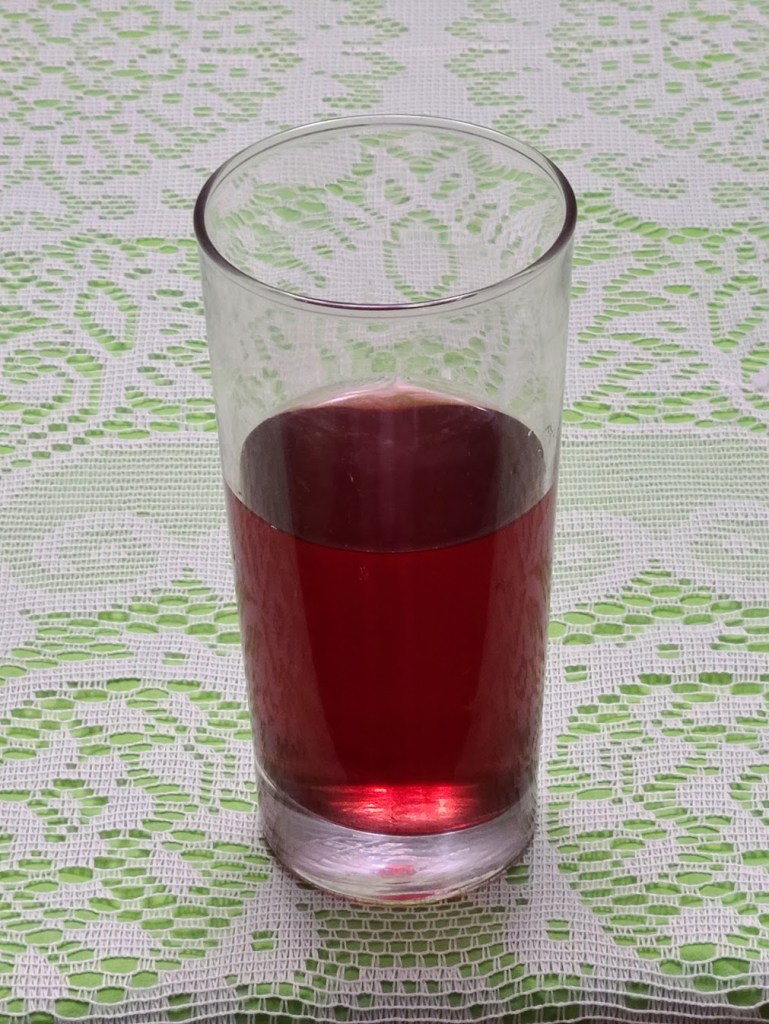
Half full or half empty? Mathematically either is correct. But which answer is the best, or most useful?
     There ae several ways we could respond when given half a glass of something:

Shock:  "Oh my gosh, I've only got half a glass!"
Curiosity:  "I wonder how come I only got a half a glass?"
Outrage:  "Hey, my glass is half empty!"
Low self-image:  "I guess I don't have what it takes to get a full glass."
Sarcasm:  "I guess that's all you can expect around here."
Positive:  "Half a glass is better than none--"

     What really makes the difference is what happens next.  Some of these responses end in complaints and cynicism, while others could end in problem-solving.
     Reader's Digest had a couple articles on optimism vs pessimism.  Not surprisingly, optimists have been found to be more successful, for at least 2 reasons:  1) If you believe something good can happen, you will keep searching for the way to make it happen (a person who believes it can't happen will never put in the energy to see it happen); 2) people are attracted to those who have a positive personality, so that person is more successful in recruiting help to solve problems.
     Although I recognize that I have faults and weaknesses, if I spend my time consumed in berating or bemoaning myself, I can never accomplish anything, unless it might be suicide.  If I never face my faults and weaknesses, likewise, I am not likely to succeed.  I need to recognize both my strengths and my weaknesses, believe in my ability to change what I don't like in myself, and put the effort into finding a way to be what I want to be.
     I feel the same way about our school and our community.  We have both strengths and weaknesses.  We can choose whether this is a happy place, or a prison.  If enough of us (both students and staff) are willing to believe in our school (believe in each of our students, believe in each of our staff members), look honestly at ourselves, search for solutions, have the courage to risk failure in order to find a way to succeed, and, keep on trying, I believe we can make our school what we want it to be.  Other schools have done it, with just as many liabilities, and we can too--if we'll believe in ourselves, and believe in each other!
     Thanks for all you do--Susan Ternyey

Written as a piece to share with the school I was working for (in the capacity of a mentor).
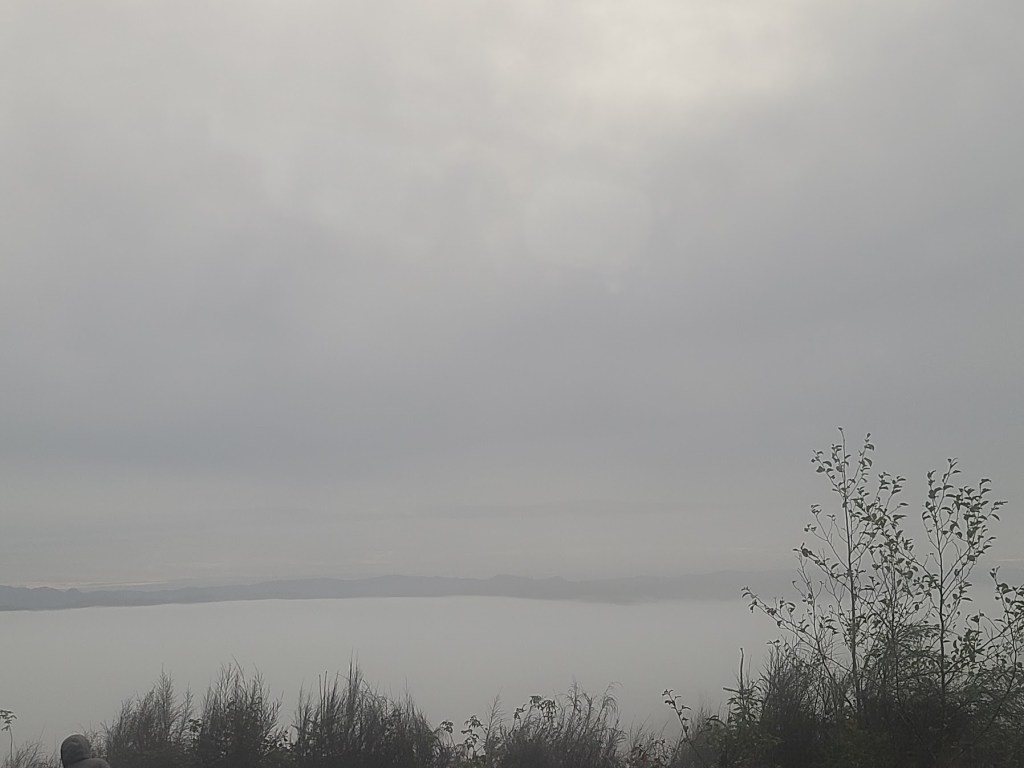
Le ciel est gris;
Il fait froid aujourd'hui.
Mais mon coeur n'il regarde pas
Parce qu'il est plein de fois:
Il sait qu'un autre jour
Le soleil le benira encore.

(less poetic translation)
The sky is gray;
It's cold today.
But my my heart is unconcerned
Because it is full of faith:
It knows that another day
The sun will bless it again.
Soy una tortuga,
quizás de Galápagos—
vieja, lenta, y tímida—
llevo mi caparazón
sobre mi espalda;
eso es mi hogar,
mi refugio, protección:
cómodo, a veces confine regido,
pero ha ayudado me sobrevivir, y . . .
adentro mis partes tiernos,
delicados, sensibles, cariñosos—
aunque posiblemente duros—
tal vez me ayudan durar
esta larga carrera formidable.


I am a tortoise,
perhaps of Galapagos—
old, slow, and timid—
I carry my shell
upon my back;
it’s my home,
my refuge, my protection:
comfortable, sometimes rigidly confining,
but it has helped me survive, and . . .
inside are my tender parts,
delicate, sensitive, caring—
although possibly tough—
perhaps they’ll help me endure
this long, formidable race.
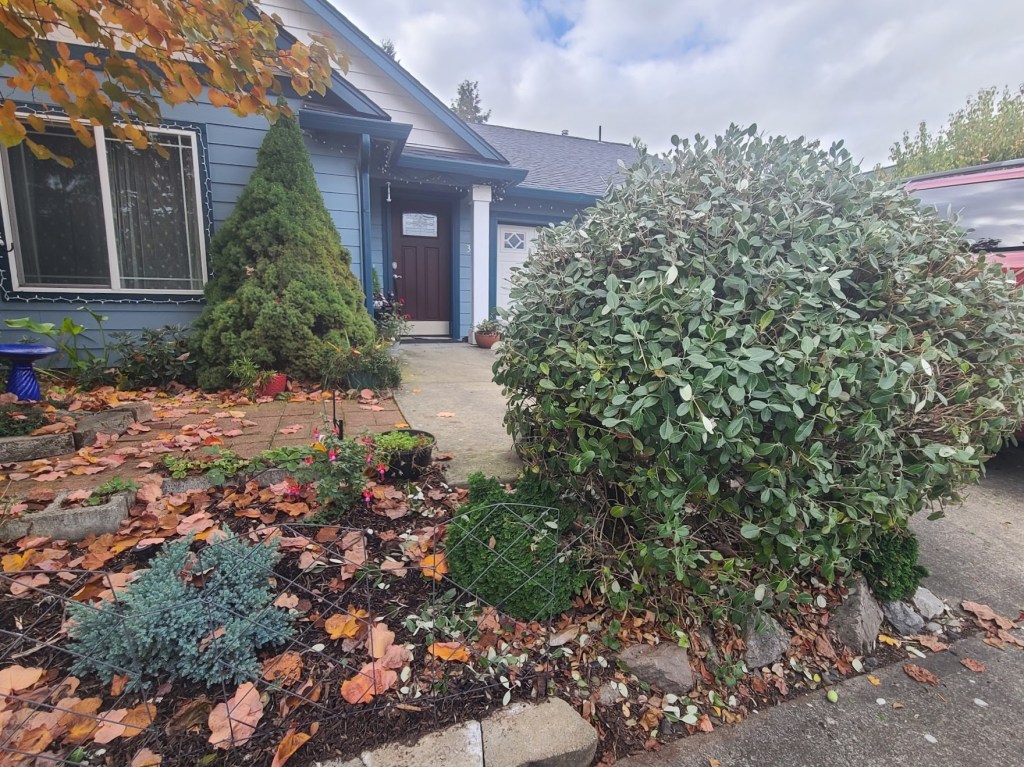
Life can be Messy–not a painting, but a photo of part of my life, fall 2023; trimming my pineapple guava bushes at right (and more) was really a stretch for me, that left me sore. Helpers came to reach what I couldn’t from my wheelchair, trimmed, piled, & bagged the trimmings from my yard.
	If Life were a painting, and I the artist, what would I paint (assuming I had the ability)?  A landscape?  I do love landscapes, serene landscapes, and dramatic ones.  I’m not sure all of life could be shown in a landscape—even if it were a collage.  A still life?  Such can be beautiful, with much to appreciate, and details to stare and wonder at—but they are still, and a life of constant stillness does not seem ultimately enriching.  A self-portrait?  I guess any painting I would do would be, in a sense, a portrait of who I am and what seems of value to me.  Yet merely a self-portrait also doesn’t capture all that life is to me, and seems too self-absorbed.  Maybe I could paint life as a bouquet.  A cut bouquet is back to the idea of still life.  What about a living bouquet, like the picture I had my grandson capture of me on Mother’s Day this year (2019), in front of one of my flower pots?  Big bold, gold iris were blooming tall, with three colors of snap dragons below.  Stems of bee balm leaves behind gave the promise of things to come.  Maybe . . .
	A few years ago I was challenged to create a quilt square to represent myself (we were designing a gift for my mother’s 75th birthday).  I gave considerable thought to that, and I think it does represent what I value in life:  I pictured myself as Sunbonnet Sue, feeding her hen and chicks.  It included a barn for provisions, flowers (including sunflowers—not because they are my favorite, but for what they symbolize), a stream, hills, I think a sunrise . . .
	Yet that doesn’t seem adequate to what I want to create this time.
	I still like the idea of a living bouquet, with colors my eyes love to drink in.  I don’t want to include clashing colors, nor weeds, even though those are a part of life—even an important part of life.  But I don’t want them to distract from what I hope would inspire those who see my work(s).
	And yes, I think it should be bold.  Although in general I like soothing colors, and music, if Life were a painting, it ought to be bold.  If it were merely a self-portrait, I don’t know that it would be too bold, even though I hold strong opinions and sometimes voice them, to the consternation of others.
	Line art can be powerful, and black and white—and they have their importance.  But I would want to use color for this painting of Life.  I love blues and greens, purples . . . but reds, yellows, whites . . . even pinks and oranges . . . well, it depends on the arrangement.  Too many colors can be overwhelming to the senses or sensibilities.  I can see myself searching out what each flower symbolizes, beside whether I enjoy its color, shape, variety—just the right amount of variety; each flower complimenting the others in shape, size, color.
	Not everything in Life’s bouquet has to be what nature, and horticulturists, have to offer.  Some glass sculptures or “yard art” also delight my mind, and give expression to my thoughts and ideas.  Subtle difference, I know—thoughts and ideas.  Thoughts can include memories, feelings, connotations.  Ideas are more logical, purposeful constructions.  Of course they are influenced by our experiences and the things we associate with each and groups of ideas, but they still seem less subjective.
	So maybe my painting of Life would have to be a whole garden.  I love my gardens—a combined work of myself and God, and lots of kind people who have helped me.  Even some contracted and paid for their work.  My gardens are not all of my life, but a garden could symbolize Life, even all of my life.  It could symbolize what I think is of value, what I would draw attention to, what I would want to say to the world.  It could include symbols of the less than perfect, the struggles (ants, squirrels, slugs . . . maybe I’ll even have to include some weeds, and some things that need tidied!), but not be so focused on them that you can’t absorb the beautiful into your soul.   Maybe I’m back to a landscape!
	I think I need to ponder this some more.
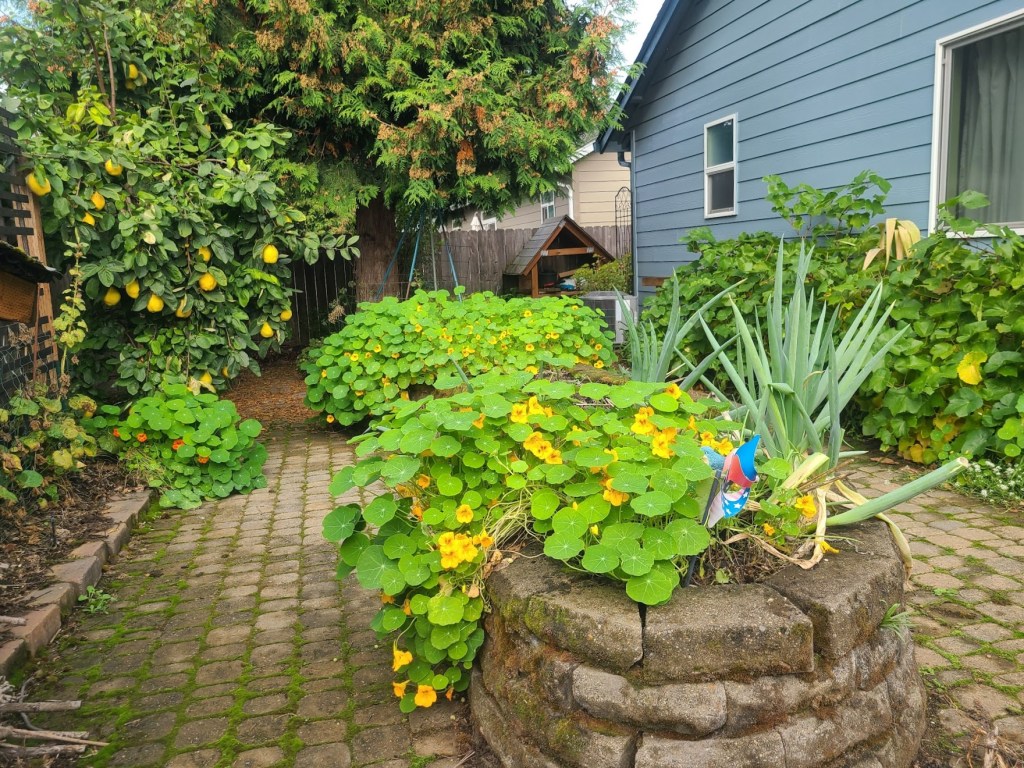
Grandma’s Backyard Gardens, in part, mid-October 2023–left to right in view: quince tree, cedar tree, nasturtiums & onions in raised bed, bunny barn back there no longer in habited by bunny (now garden gear), grapes along the house.
A New Start
	A certain woman, a paralytic grandmother of 50, acquired a lot in a certain city, in a subdivision, with certain covenants.  The lot appeared level, and was chosen for that reason.  But by the time the foundation was dug and poured, it was no longer level, and required a ramp for access to the home being built.  The builder, not of highest repute, was nonetheless willing to make many accommodations for the paralytic.  While the woman recognized that the home would not be of superior quality, and that the prices had not yet quite bottomed out, she felt it was best to get what she could when it was available.  Other disappointments came along (like the narrowness of the street that didn’t allow parking on her side), but she felt she could either walk away until all could be perfect, and she could afford perfection--never have anything--or she could be willing to compromise, in order to be able to have something.

Groundwork
	It was soon apparent that the ground was a haphazard mélange of clay, gravel, and sand.  It seemed it had been the clay bottom of a pond, with construction gravel and sand dumped rather indiscriminately near the street and drive.  A French drain had to be installed along the line next to the uphill neighbor.  Over years and years, various amendments had to be added for gardens to succeed.

Whose Plan?
	The city had made certain requirements of the builder—for instance 3 trees on the lot—regardless of whether they would be the kind or the placement the new owner would want.  The woman was able to negotiate to change out 2 of the trees--from a list.  The woman was required to submit a plan to the city, showing her intentions for the place.  The woman researched and chose a variety of shrubs she thought she would plant—knowing, of course, that one must live in a place for some time before one knows where to plant what.
	In the meantime, her mother-partner, her neighbors, friends, family, all had their ideas about what should and shouldn’t be planted where.  Her grandson ever lobbied for a fountain or water feature.  She and her partner wanted to extend the blooming season of the gardens just as long as possible.  There was the issue of affordability, and the partner brought many, many plants to transplant from her previous place.  And then, every trip to a nursery might bring home one or more plants that captured the interest of the women.  But space and circumstance would eventually circumvent  certain changes—it would be too late to do things differently.  If it could have been done all at once, the gardens might have had a more comprehensive plan.  But who could know, so early on, what changes would come?
Changes
	Over 10 (then 15) years, major changes almost entirely redesigned the woman’s gardens.  They wanted to try espalier, and grapes, and  . . . lots of other things:  everything was an experiment, and some were tried again, and again.  Not everything thrived where it was first planted, not everything survived at all.  Some things were beyond the ability of the woman to care for.  The wisteria, the espalier, the grapes, the grass had to go.  Each was changed to things easier for her to manage. Watering systems changed over the years, and eventually she was able to have a contractor install a sprinkler system (which she continued to tweak).  Over time the woman became aware of other plants she wanted to try.  Things that began small, grew large.  Change became constant, even if less overwhelming.

Kinder-Garten
	Being a grandmother, the woman wanted as kid-friendly a yard as possible, acquired various toys, kiddie pools that changed every couple years, and planted things the kids were encouraged to eat right from the garden.  In truth, the woman enjoyed that herself.  She loved watching pinwheels spinning in the wind.  She loved miniature fairy gardens.  She loved the laughter of little ones.

Farm & Garden Grandma
	And pets:  the woman let the children collect worms, slugs, snails for pets.  For herself, she tried miniature frogs in a small enclosed tank, a cat the kids were to help care for, a bunny with its barn over one of the compost piles (but as it turned out, had to come in for the winter), and chickens the children helped to raise until they were grown—the chickens, that is.  A dog would not do.  The woman was not willing to pick up its doodoo.  At last the woman had to admit that she could not care for pets, and the last dogs she bought were stuffed animals—easy to take care of, ate little, and pooped less.  She had previously tried fish—gold and beta—they died; would like to have had birds, but the pretty cages cost too much, and birds flick.  So she just enjoyed those birds that shared her garden with her (despite consternation over their cherry picking, and poops).

Laborers in the Yard
	Hired hands put in the patio, sidewalks, garden shed, pavers in the back, the final (one hopes) sprinkler system.  A brother put in the main raised bed, espalier posts, grape supports, painted the shed, helped one round of soil amendments, and one round of gate amending.  The woman managed to put in much of the block frameworks for edgings, gates, more raised beds.  Her mother, in her 70s with difficulty balancing, hauled her wheelbarrow handcart full of dirt, over and over one summer.  And the two women planted almost everything—an eclectic collection--themselves.  Church members, missionaries, various temporary housemates, neighbors, friends,  family—especially her grandson--all helped her in the work.  How many times has her grandson unloaded blocks, boards, bags of soil and such, beside weeding, trimming, reaching, carrying . . . ?  It was a way for him to earn money, and for grandma to have a regular helper.  Eventually others had to take his place, as his life moved on.

Compost, Chemicals, and Firepit
	The woman built two compost bins for developing soil from home and yard waste. But she had found sometime earlier that one way to fill a pot for less, was to layer kitchen and garden scraps  with bagged soil.  She called them her “pot garden”, and they served a variety of plants, eventually becoming the potato and squash pots. Every garden space became a compost for trimmings as well, both to build up the soil and to save the cost of city collection.   The firepit became a way to recycle prunings, beside providing a cooking and gathering place.  She decided the ashes might discourage ants and slugs, and encourage plant growth.  Yet, she invested yearly in many and various chemicals to try to check the destroyers--

The Destroyers
	Moles, ants, cats. and blackberries crossed the fence line.  Weedy seeds came blowin’ in the wind.  Squirrels—so adorable, so exasperating—“dug” her garden, for hiding and finding their nuts, nibbling tender roots, the fence serving as a superhighway from yard to yard.  Slugs seemed to procreate ex nihilo.  Winter cold, summer heat, drying winds, too much rain, too little rain, too much sun, too little sun . . . the life and death of the gardens.  Insects, disease . . . every mortal enemy she battled endlessly.  Appreciating all creatures great and small the Lord God made withal, yet like every other creature, she considered it her right to defend her territory from invaders, marauders, competitors.

Frugal Food?
	How satisfying to her soul was growing food to eat and share.  But did it save any money?  Considering the cost of chemicals and water?  In her accounting, she decided that nearly every landscape would cost to maintain, and so, like the chickens she kept both for eggs and as pets, she might as well get some return for the pounds she invested.  The aronia berries—well . . . they were so prolific, so nutritious, so . . . astringent!  Too much a daughter of her mother to let them go to waste, she mixed them with blueberries, or added them like blueberries to her pancakes.  Few people wanted to share in that harvest.  Ironically, despite their producing freely, their preservation necessitated so much sugar and additional blueberries from the store, they were not free.

Neighbors and Dog Walkers
	The closer one lives to others, the more potential for misunderstandings, for disagreements, for disagreeableness.  Good fences make good neighbors?  Well, depending on whether one neighbor influences the fence line to his advantage, and whether the fence keeps various plants and animals from crossing the line.  But this woman did not want to be enemies with her neighbors.  All in all, they were mostly good neighbors.  Better to try to cultivate friendship than a tangle of thorny relationships.  Not always easy, sometimes fuminously difficult.

Beauty All Around—indoors and out
	The woman loved the colors of gardens, the patterns of plants, for her décor inside as well as out.  Though less than brilliant with houseplants, she grew a few (that had to be replaced from time to time).  She painted her rooms (thanks to helpers) with garden colors, and bought curtains with botanical designs.  Her mother and she hung crystals from the kitchen window to play in the light, and delight the children with dancing rainbows.  Her soul craved beauty.

Windows on the World
	Windows let in light.  Windows opened the view to the gardens—and she planted so that the flowers would grow to show through the windows.  She wanted looking out, even on a dreary day, to be a delight to the eyes and heart.

The Gardens of the Lord—Eden & Gethsemane
	Compliments about her gardens always caused her embarrassed, humble pleasure.  How could she take credit for what was beautiful in them?  Though she put in pretty continuous work and watchfulness, and sometimes long hard days, beside whatever resources she could, could she really make anything grow?  She had witnessed the death of too many things to believe that.  Had she created any of the natural (or bred) beauty of any of the plants in her garden?  Her gardens seemed to her gifts from God, especially when her life otherwise (or even in the gardens) might be giving her miseries.

Roses are sometimes red, and Violets can make you blue
	Violets are so pretty, but they are spreaders (one of many)—and would take over the world if given half a chance.  Roses come in so many delectable colors . . . with a limited lot, how can you choose?  And rose cultivation has its thorns, and diseases.  Roses were a favorite of someones in the woman’s life, and perhaps symbolized her relationships with them, like the Bette Midler song “The Rose”.  Likewise, Grandma’s Gardens.

“Hear ye therefore the parable . . .”
	The woman chose her life the best she could, with the information and resources she had. Still, she could not control everything about her life.  It required all kinds of exertion and “amendments”, compromise and negotiation, to try to make beauty and a reasonable yield from what she had to work with.
	Changes happened in the woman’s life.  Some things didn’t work.  The kids and she grew up and older.  Her goals, desires, and pursuits changed.  What she was able to accomplish with her resources changed.  In a sense, life became a series of experiments, trials and errors—and sometimes delightful successes!
	The woman did as much for herself as she could, but she could not do it all alone.  This was both a curse and a blessing.  It was frustrating to have to accommodate her plans and ideas  to the convenience, conceptions, and quality of work she could get from others.  Yet it was a blessing that others were willing to help with what she was not capable or skilled to do.  And it built the bond between her and her most important others.
	In accounting for her life, financial considerations were not the only considerations.  There were other things she valued, and despite the destroyers of her intentions and efforts, she put all she had into winning what she hoped for in life.  Ultimately, the thorns were less important to her than the roses.
I did not choose the easy road,
Though I saw it from my own,
But what I wanted--
A full and happy life--
The easy road could not but loan.

I sometimes chose the heavier load,
And often felt I bore it alone,
But what I needed--
Charactered strength--
The heavier load gave me to own.

I did not choose the easy road . . .
That road wouldn't satisfy me;
I sometimes chose the heavier load . . .
And willingly(?) waded through misery.
But to me, the easy was much too hard;
The simple was far more complex:
The less heavy burden yet heavier still
Than the one I chose to heft.

And in the end, though my life well shows
All the stumbles and struggles and falls,
I cannot say that if I walked it again
I would change my choices at all.
I left your presence, Home,
So short a time ago--
O how could so much experience
Be crammed in so short a space:
A life within a life.
I marvel as I look back--
Am I much changed?
The impressions are so deep,
Will they be scars, or Wisdom's wrinkles?
And now I return,
So anxious to see You again.
I file all these experiences away
To be slowly sorted in moments of musing.
I love You,
Please take me in Your arms
And give me a reassuring embrace;
I tried to serve faithfully.
I didn't run very fast--
She began behind, but soon surpassed me.
I set my pace,
Struggling against the tightness,
Uncomfortable with the effort.
She was in better shape to begin; while I had put on weight.
But I was out for my own good,
And now I was here,
I was going to do it, I determined.

I didn't run very fast--
She ran circles 'round me, frustrated at my pace;
I was tempted to quit and walk,
But, I thought, "just to the next crossing . . ."
Then, almost there, I thought
"I can make it beyond."
After I passed that mark,
Again, I wanted to quit and walk,
But told myself, "just to the next crossing . . ."

I didn't run very fast--
But at last made it to the end
(Which was uphill,
Yet I made it).
The last stretch I really wanted to quit,
Instead I "poured on the steam"
And was surprised I had any to give!

I thought I would give out, crumble . . .
But I kept in motion--
Even those last 5 yards--
Although I was tempted . . .
I didn't slow down, didn't quit
Until I hit home.
Now I know I can make it, because I did.
My childhood days
are remembered a little faintly.
Both happy times and foolish ways--
I'd not return
To re-live or change--
I look forward,
Even if a bit dubiously.

Then came the years
Of deciding what to be:
Sampling enough of both good and evil
Which fruits I tasted,
I grew to know and desire what was sweet,
Mourning bitterly the tasting that seemed wasted.

I went out to bless and gather,
But found myself the blessed, rather,
And deep sank insight.
When I married I meant to bless,
And found myself a 'saint' much less
Than ever I had considered:
Still more insight gained.

I bore a child, and she was all to me,
As were my Church and Family.
And more and more I knew
What was worth most in Life,
And what I wanted to do.

Then more major trials came--
So deep I nearly drowned--
Lost my course and my direction;
The storm was fierce and worsened.
I could only 'hang on'
Whatever rope I could grope with all I had
Hoping rough seas would not continue longer.

Suddenly all was changed--
I seemed in a different boat!
(At least this boat did float . . .)
If wisdom I have not gained,
I know not how to name,
Only call it "Experience".
Far humbler than the poet whom I appeal
As tutor, in aspiring to convey
And 'scribe in characters of the Ideal
Those worthy merits, in this worldly fray,
Which we would urge on any that we may--
Most 'specially our children and their own--
That seem to us appropriate array
For one who hopes to win wherewith to don;
I, trembling, take my pen and timid make this poem.

In olden time when poets sought to rhyme,
A meter and a rhythm they adop'd--
Adhered they well to form they self-assigned--
In the present matter so I shall opt.
Ancient symbol rallied ardor, held aloft,
So too, our clan designed a coat of arms:
Historic emblem, archetype undrop'd,
Not obsolete, though touched by modern larmes--
So may this verse prevail with such archaic charms.

Then, too, the poet would sincere implore
To help him in his overwhelming charge
Some muse, or two, or even yet a score--
Whomever may've been roaming then at large.
But I must, sadly, thus my work dispar'ge:
That I have none of Muse to help amuse.
So if I'm dull or my meter seems to barge
The very doors of hearing, and you lose
The sense--you then may well my labors all refuse.
"A Gentle Knight was pricking on the plaine,
Ycladd in mightie arms and silver shield . . ."
Edmund Spencer, The Faerie Queene
"Come forward sir," the heralde loud doth crie,
"Show forth thy colours, blazon aegis bold.
Tell out thy kin, thy motto carry high--
If thou art noble, thy heritage up-hold!"
Proud the champion raised, the crowd behold:
Th' exalted standard gleamed so splendidly
The trumps blared out as if they had been told,
And steed and man reared up in harmony;
Then all the crowd roared out a shout majestically.

Who is this knight, magnificent to see?
Interpret now his lordly coat of arms.
A ram, as head, depicts his family:
For Rahms who came of Switzer, land of farms--
Hallau yet bears the Ram-crest o'er its barns.
Harry, born Rahm, transmits this legacy
Of strength--in silver-grey the pledge is sworn:
Not only strength, but adding Purity.
In blue discerne ye Honour, Truth, and Loyalty.

Precious yellow gold, valued, ever-searched,
Crowning richly earthly kings--but, seeks he
Honour more precious, more valuable Truth,
A more kingly crown:  priceless Loyalty.
A crown, in truth, denotes proud royalty,
And so traced in his ancestry are kings;
Of Heaven, too, his worth comes honestly--
Redeemed from Death, to Christ he stalwart clings,
And of God our Father his soul took buoyant wing.

Chivalrous Knight, protect from every foe
Thy Kindred, thine Honor, and thy Beloved,
As thy helmet protects thee from death's blow;
These look to thee, their defense--so do prove
Nor whom, nor what, nor traps for them awov'n
Shall bring them down to ruin or ravage dread--
Evil by thy tongue or sword is cloven;
Nor let thy cherished want in lack of bread,
But give thou of thy board, and of thy table, spread.

Thy shielde bear'th bravely sword and star and scroll;
The sword points to thy virtues previous told--
Defend them well, let not that keen edge dull;
But n'er aggressor, as the pattern old
Intended not, provoking, to be pulled.
The star points, too, give direction and light
To those who watch the Heav'ns as they unfold--
Wise men, the ancients mapped the starry night,
And sought for, ever, knowledge, prophecy, and Right.

Upon the scroll a tree be ascertained,
Symbolic Knowledge, Life, and Family.
Both generations gone and that remain
Are written in its branches, rootes, and leaves:
An unfinished legende that grows and breathes;
On other leaves are written all the lives
For those who come yet later in Life's weave:
A tapestry of children, husbands, wives . . .
Many-colored coats . . . some leaving, some just arrived.

A braid entwines six offspring bound in love,
Resolved amongst them to the self-same end,
That like them, all their children will be one:
Stars that in their spheres to harmony lend,
Each his own part, each his voice well blends
In order, method, symmetry--transposed
To meet each challenge Life may haply send;
In other key the melody composed
Sings still as sung before, and on and on it flows.

And tell us of the flow'r he wears so gay,
And whose that mantling scarf may be--her name.
The Rose is Vera, Gerber was she nee,
Then married Harry, Clark she then became.
For he, as child, when adverse trials came,
Was fostered by the Clarks--the scroll recalls
That "clark" and "clerk" once were the very same.
So Rahm was Clark, and Vera, Clark--it falls
That tot and tribe are known now as "the Clarks", withal.



 My Stories