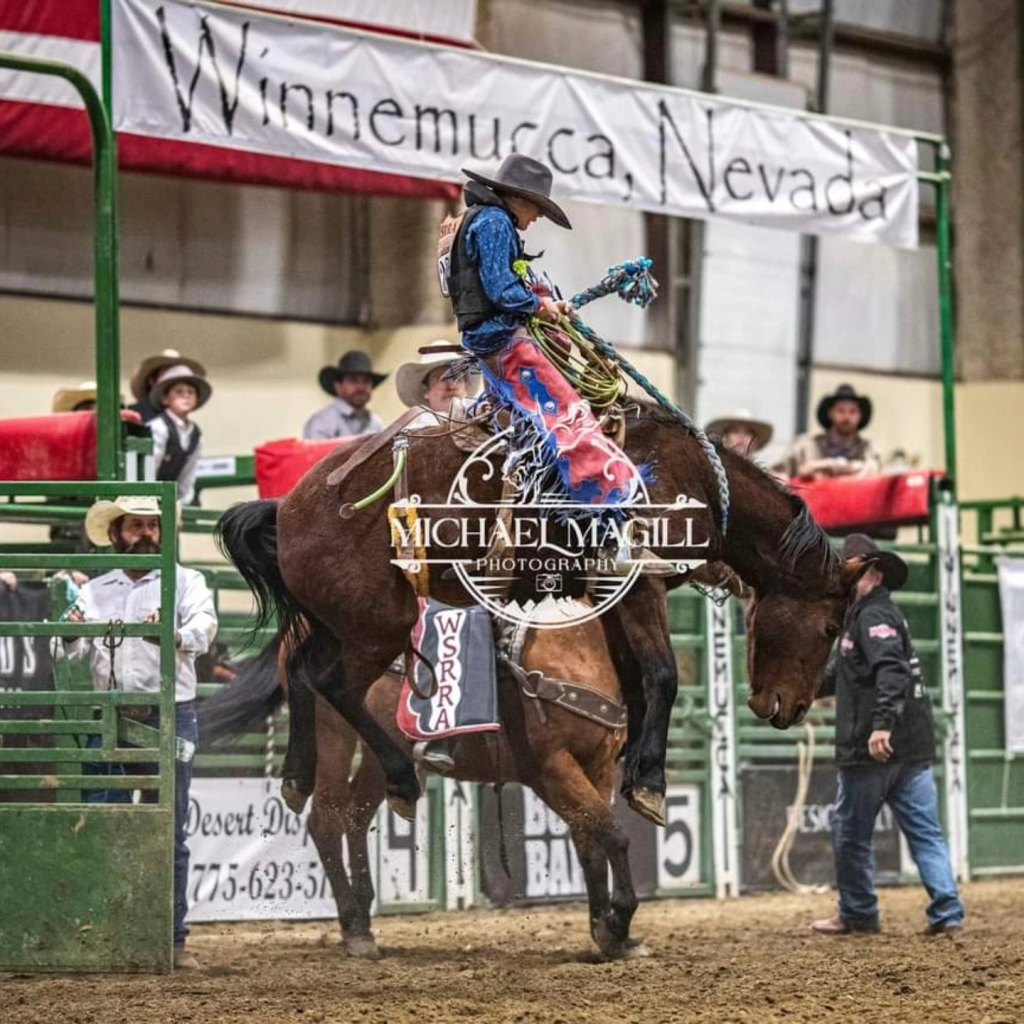
Not a bull, but a bronc. Posted by Ashley Walker on FB.
I recently heard the song "Live Like You Were Dying" by Tim McGraw.
He said “I was in my early forties With a lot of life before me And a moment came that stopped me on a dime I spent most of the next days Looking at the x-rays Talkin’ ’bout the options And talkin’ ’bout sweet time” I asked him “When it sank in That this might really be the real end How’s it hit you When you get that kind of news? Man, what’d you do?”
He said “I went skydiving I went Rocky Mountain climbing I went 2.7 seconds on a bull named Fumanchu And I loved deeper And I spoke sweeter And I gave forgiveness I’d been denying” And he said “Someday I hope you get the chance To live like you were dying”
He said “I was finally the husband That most of the time I wasn’t And I became a friend a friend would like to have And all of a sudden going fishin’ Wasn’t such an imposition And I went three times that year I lost my dad I finally read the Good Book, and I Took a good, long, hard look At what I’d do if I could do it all again And then
I went skydiving I went Rocky Mountain climbing I went 2.7 seconds on a bull named Fumanchu And I loved deeper And I spoke sweeter And I gave forgiveness I’d been denying” And he said “Someday I hope you get the chance To live like you were dying Like tomorrow was a gift And you’ve got eternity To think about What you’d do with it What could you do with it What did I do with it? What would I do with it?
Skydiving I went Rocky mountain climbing I went 2.7 seconds on a bull named Fumanchu And I loved deeper And I spoke sweeter And I watched an eagle as it was flying” And he said “Someday I hope you get the chance To live like you were dying To live like you were dying To live like you were dying”
     Every day I'm dying.  The questions are:  How long will it take?  How will I go?  What legacy will I leave? to start with.
     I wish I could write about it poetically, wish my life were poetic (not just poetic justice), or a great drama that would impact all who saw it in a powerful way.
     In my allotment, there's no skydiving, no Rocky Mountain climbing, no bull riding.
     Skydiving would scare the hell out of me, and what would be the purpose, other than that?  Merely to show courage?  Surely there are more important, valuable ways of being courageous.  It depends whether that skydiving was to save a life or a land, perhaps.
     I'd love to go Rocky Mountain climbing, but I have some limitations in that pursuit--means and mobility issues.  I am genuinely grateful for the travel I have done these last years, particularly.  Glad, grateful, I didn't put it off, thinking I could manage it better in some future, because this is that future, and such pursuits are less and less manageable for me.  Push against the pain?  I do, even if not as impressively as some athletes or others.  I think it not wise to ignore my body altogether, if I want to accomplish anything else in life.  Life is a balancing act, a negotiation, a conversation with compromise, hopefully not soul-compromising.
     Bull riding is meaningful for some, I have no criticism of them.  It's not an option for me.  The bulls I ride are of a different sort:  struggles with the challenges of my body, and they can be personally rough riding.  I'm so grateful for my daughter, who comes to my rescue and faces my feces with cheerful willingness . . . never making me feel bad about what I can't help.  Others, too, have rescued me in my various needs--my grandson and other family members, friends, acquaintances, even strangers.  I hope they have felt the gratitude I have tried to express, though perhaps poorly succeeded.
     If I knew I only had 3 years left to live in this world, what would I pursue?  Nothing so spectacular as skydiving--
     I want to come to some satisfying point in my projects.  They'll never be "done", but I want to feel some sort of completeness, as in a chapter that leaves a settled feeling.  One knows the story isn't over, but, like the final episode of "The Onedin Line", there is a sense of completion, even perhaps of an era.
     I would (as in "to do in future" as well as "have a will to do") continue to invest in whatever opportunities I may have to be a positive part of the lives of my loved ones--family and friends.  To do all I can to be an influence for good in their lives, bring whatever joy and significance to their lives I can.  So also in the lives of those to come, in whatever sphere I have in this world:  may my life be a meaningful contribution, not in dollars, but in sense.  I know I can only be of modest impact; I'm not seeking to be a bust on a pillar/pedestal, nor the pretentious adoration of the famous of today (or ever, I suppose).  I like to be appreciated, without having my name in lights at some gala full of applause and disingenuous speeches.
     My last days, as any of my days, I want to enjoy my gardens/yard, the beauties of the earth and God's creations.
     If perhaps my end is painful, I hope I can bear it courageously, not bitterly.  I hope I don't make it a misery for others.  I hope not to suffer, but if it must be so, may I pray, as Christ exemplified, "Thy will be done" in my life, and through my life.  Amen.
Reflections on the past
Reflecting on the future,
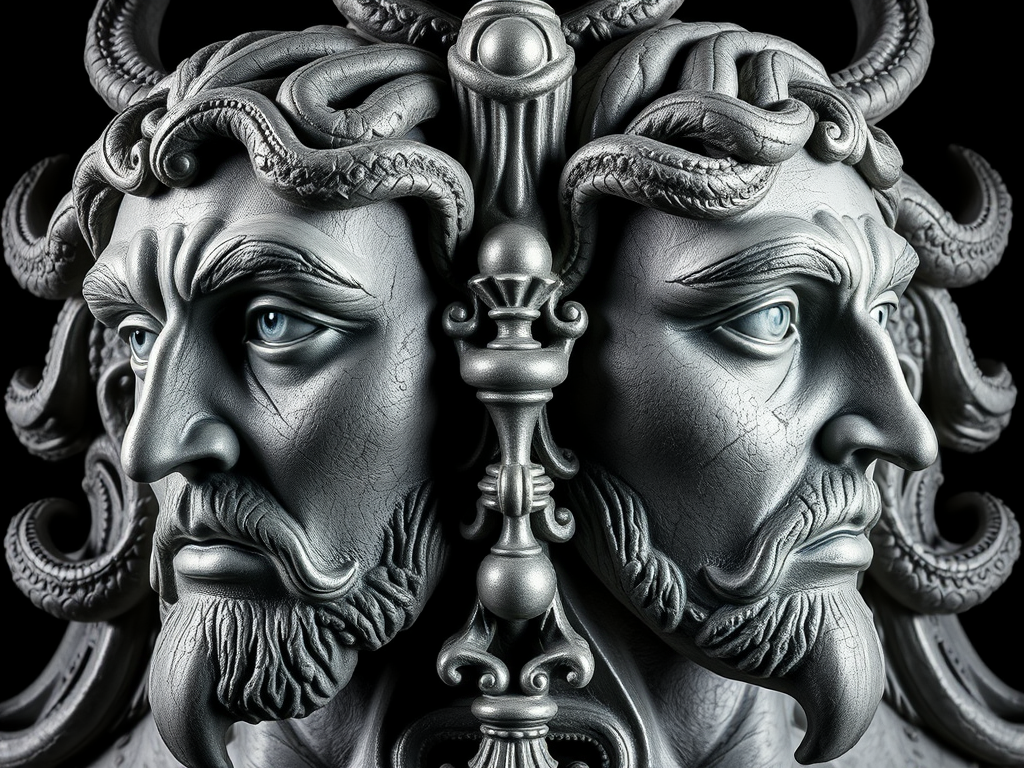
Janus is the entryway:
Looks backward and forward--
     not as a two-faced, but a two sided straight face
     (though maybe sometimes with humor . . .
     there must be humor!).
I look in the mirror
At what I've done, what I was,
And then at what I might do, might become . . .
     resisting hopelessness in frustration
     for my shortfalls, as well as long falls . . .
Wearing blinders against distractions
     (unless a break is needful),
     hopefully not against the Truth,
Helping me to focus on good ends.
I ask myself
What do I want to do?
What do I want to be?
How has what I've done and been
    helped or hurt my pursuits?
And how shall I do and be my best?
It's a perspective to ponder every day.
     James Onedin wants to be his own master, his life under his own command; he wants to own his own destiny.  He is a ship’s captain, and his employer, Callon, has dangled the promise of having his own command for nearly 6 years (S1 E2).  Although James has pressed himself, the ship, and crew hard in order to fulfill his employer’s expectations and earn a bonus for making a fast passage, his boss Callon  (the owner of the shipping line), only finds fault with both James and the crew for circumstances they could not help (the weather) and cargo losses.
     When he is paid (his earned bonus held back due to losses), James sees the advertisement of a ship (the “Charlotte Rhodes”) to be auctioned.  He asks his brother Robert (who has just inherited the family’s shop on the recent death of their father) to lend him money to make up the difference between his own savings and the expected price of the ship.  His brother refuses what he considers a highly risky, foolish venture.  Like their father, Robert is cautious in business.  Robert claims that James has no head for business.  We shall see.
     James already has a relationship with the Portuguese wine merchant Braganza, as ship’s captain for his employer Callon.  He knows the contract between them is expiring soon.  He notices that casks are far more valuable than what they carry.  He does due diligence in finding out the shape the ship is in, as well as the situation of the ship’s owner.  We soon find that he is a shrewd negotiator, when he goes to see the owner of the “Charlotte Rhodes”, the retired Naval Captain Webster, a cantankerous self-important old alcoholic who can’t afford to keep his ship in service.
     At his knock, Capt. Webster’s daughter Anne guardedly answers the door and suspiciously asks what he wants.  James tells her that it’s a matter of business he wishes to discuss with her father, concerning his ship.  She invites him in and announces him to her dilapidated father (helping him get spruced up as best they can do on short notice:  she wishes he’d bothered to shave that day, and he wants his uniform, which is all he has—the rest being in hock).  She asks James in an assertive tone whether he minds that a woman be present in the negotiation, making excuses for her father, and not wanting him to be taken advantage of.  She is the one who actually does the negotiating for her father.  James makes himself amenable.  When they sit down to negotiate and he is offered a drink of wine, he declines, saying that he prefers to keep a clear head when discussing business.
     To Anne’s price of 650 guineas, he makes a counter-offer of £175 in gold (to their shock and accusations from Capt. Webster that he is a rogue), and a partnership; he will bear the cost of having the ship refitted for sail himself.  Capt. Webster plainly considers himself above the Onedins’ class.  He characterizes the family as “pious, parsimonious” shopkeepers.  James vigorously lays out their situation and the benefits of the bargain, saying, “Before one can negotiate with certainty, it is necessary to fully comprehend the strengths and weaknesses of the other side.”   Capt. Webster calls him a villain and orders him out of the house.  Anne deftly steers James toward the door, saying that her father wishes to consider the matter closed, yet directs James into the kitchen and gives her father his alcoholic “tot” to send him to another room.
     Anne sternly confronts James, “Are you a fool or a charlatan?”  But then she lays her own cards, as well as his, on the table.  A partnership with her father would mean James would inherit upon her father’s death.  Despite any good intentions, that would be the result.  The exchange between Anne & James is one of the classics of the whole series, as they each consider what their bargain would mean.
     “I have little taste for penury.  One day my father’s weakness will assuredly drive him to the grave, and I shall be left penniless,” Anne admits.  “At best I shall be constrained to live off the charity of friends; at worst, it will mean the poorhouse.  I can assure you I have little fancy for either.  You understand the problem . . .”
     “Security,” James correctly deduces.
     “In return for the ship.”
     “I’ll not hide it from you Miss Webster, I cannot put up surety.”
     “And there is my father to be considered.  He’s a weak and foolish old man, but I would not see him destitute,” Anne at once shows her grasp of reality and her conscience.  She has quickly devised a solution.  “There is only one form of partnership that would ensure the sort of security I require, and the ship would not cost you one penny piece . . . as a dowry . . . There is only one way a woman may escape poverty, Captain Onedin.”
     “Marriage?” he looks at her quizzically with his head cocked.
     “A not uncommon arrangement,” Anne asserts firmly.
     “You strike a hard bargain, Miss Webster,” James deliberates.
     “Am I so unbecoming?”  (Robert described her as vinegar-faced, tart as a crabapple, and the wrong side of 30.)
     “Well, I’m no great romantic, but . . . matters such as this require a deal of thought . . .”
     “And I took you for a man quick to decision.”  She has shown her own such qualities:  decisiveness and acumen.
     “Well, you might not find me so great a catch, either . . .”
     “I should have the protection of your name and a share in your success.”
     “Yeah, or failure.”
     “I think you and failure to be poor bedfellows . . .” she discerns.
     “It’s a grave risk . . .”
     “Then we will say no more of it,” she concludes quickly.
     “Well, I mean for you . . .” he recovers himself somewhat.  “I ask you to consider carefully, Miss Webster, you might be exchanging one form of poverty for another.  I have but £175 in the world.”
     “And ambition.”
     “Oh, yeah.  I’ve ambition enough for an army of Napoleons, but ambition won’t feed us, clothe us, pay creditors.”
     “You would be hard put to find a better housekeeper, and a less complaining; I’m well-trained on that score, I can assure you,” she adds, both reflecting on her life with father, and attempting to persuade.
     “It is no easy road, one I would prefer to walk alone,” he advisedly states.
     “A few minutes ago you were speaking of partnership.”
     “Yeah, I could buy myself out of that kind of partnership, but the one you have in mind, that’s for life,” he ends on an upward note.
     “For better, for worse,” Anne acknowledges.
     James walks the room, considering.  “For richer or poorer,” he almost challenges.
     “I therefore plight thee my troth,” Anne softly offers.
     James slowly thinks aloud of all the ship will need for refitting.
     “It is a bargain, then?” Anne asks.
     James nods a little stiffly, “I wonder which of us will have the better of it.”

     When James returns to his family, they are shocked at the idea that he would suddenly marry the plain and poor Miss Webster.  Their reactions are telling:

Robert laughs and calls James a sly dog, implying the conventional need for a quick marriage.

James:  it’s simply a marriage of convenience . . . (in order to get the ship) . . . It’s as valid a reason as any for contracting an alliance . . . A ship is as much property as any heap of bricks and mortar [referring to the shop Robert so highly values, no doubt].  And a far more profitable investment.

Robert’s wife Sarah:  People marry for mutual regard, not for profit.

Their sister Elizabeth:  For love, James, for love.

James:  Well, then the more fool, they.  I cannot see how any man can keep cool judgment when in the grip of such a humor . . . I’m content with the bargain!

     James then gets Robert to sign a partnership agreement for the 1st voyage, leaving £150 in gleaming gold coin (dazzling Robert) to pay for refitting and victualing the ship, and promising half of the profits of the voyage.  As partner, Robert is also bound to pay any debts incurred by the voyage (such as the allotment spouses of the sailors get halfway through the voyage).  Who else could James trust to take care of his interests?
     When Anne sees the contract, she calls James a scoundrel for promising Robert half their profits.  She’s in such a flurry of ruffled feathers James can hardly get her calmed.  He tells her, “I’ll not be berated either before or after marriage.”  He gets her to see what the contract actually says.  She will not have to deal with creditors while he’s away, and he intends that there won’t actually be any profit from the voyage to split.  James assures her, “In matters of business, I give nothing away.”
     After they are married (having had the bans read 3 weeks earlier), and they have their reception aboard the ship, Anne insists that she sail with James.  He says it’s no place for a woman, to which she replies, “A wife’s place is beside her husband.”  And when he tells her he plans to drive the ship hard and it could be dangerous, she says, “I’ve no more fancy for widowhood than spinsterhood, James.  We sink or swim together.”  He bows to her forceful will, which matches his own.  Two peas from the same pod, an acquaintance describes them, and that is true of both their natures and interests.
     As they prepare for their first night together (on the voyage), Anne bemoans her plain looks.  James gently comforts her, “If men married for beauty alone, there would be a power of lonely women in the world.”  The next morning as she is sewing a company flag she has designed for their venture, they steal a glimpse of each other that silently speaks of their mutual satisfaction.  In the 2nd episode James kindly teaches her how to navigate (though she’ll be called upon to use her scarcely learned skill before she feels confident/competent to do so), and it’s clear they both love sailing the ocean.
     James had immediately got the work started on the ship.  Callon is suspicious.  He realizes James is after the Braganza contract.  He sails in his faster ship and beats James to Lisbon, offering Braganza the best bargain he’s ever made.  The ever-affable Braganza delays signing until James arrives, who has writ him a letter asking him to wait to see what he can offer.  After an exchange we see that Braganza is also a shrewd bargainer.  He knows that Callon’s topmost concern is to put James out of business, not any real care for himself and his interests.  James says he’ll ship the wine for free, in exchange for being sole agent in the sale of Braganza’s wine in the UK, and that he will return the empty casks at full freight charge.  Braganza chooses James’ offer, and Callon leaves in anger vowing essentially to crush James and his newly created enterprise.
     Already in the first episode several themes have been introduced, as well as the characters, and the setting (the evolving times of the 1860s and forward—in Liverpool England, on the seas, and an ever-widening scope in the world).  Unmentioned above is the initiation of the love triangle between sister Elizabeth and her 2 suitors (Fogarty & Frazer), the dysfunctional relationships of the Onedin family, and the clash of their faults and philosophies in life.  These and more move the drama of the story along.  But here is a partial proposal of themes that can be explored through this series.

1.	Business Sense:  including employer/employee relations, rivalries, success & failure
2.	Self-determination:  including freedom & slavery, class, spousal & parental control …
3.	Friendship:  its meaning, loyalty, influence for good and ill
4.	Family:  marriage, love, children
5.	Loss & grief experienced in life
6.	Religion & superstition:  public & private observance, and Faith
7.	A historical look at Health & Welfare:  at sea and land, by law, by class, by sex, by place, through harsh times, and compensation for injury & death
8.	Justice & Goodness:  character(s)

     Perhaps over time I will be able to pursue writing my absorption in this epic.  Among the appeals of the story are historic sailing ships, the beginning of steam ships, sea shanties, historic commerce and culture, Victorian manners and mores, as well as literary (and life) themes, and more.
In order to compare contemporary writings on the society of the Victorian Era, I looked for the literature of the period, remembering in particular Dicken’s novels. But then I realized that these were written (as was the “Onedin Line”) to market in the media of the time: magazines and books. As the “Onedin Line” story is propelled by characters, plots, and conflicts, so the writers of the 2nd half of the 19th century perhaps did not focus on the most laudable and peaceful aspects of life and society at the time. So, while we can learn something of the culture, we must be cautious of being too gullible about how such depictions could be generalized. A well-known influencer of the time was John Stuart Mill. The generation just preceding the time period of the “Onedin Line” possibly produced gentler literature, such as the stories of “Cranford”. Yet Dickens himself began writing in the 1830s, and the Bronte sisters wrote some dark novels before when the "Onedin Line" is set. I wanted to make more particular note of those closer to the timeframe of the “Onedin Line”. The same themes can be explored in these writings:
Elizabeth GaskellNorth and South (1855) https://www.elizabethgaskell.org/works-novels.php “Cranford” TV series based on Gaskill’s writings pub 1849-1858 (the decade before Onedin) https://en.m.wikipedia.org/wiki/Cranford_(TV_series)
Charles DickensGreat Expectations (1860), Our Mutual Friend (1864), The Mystery of Edwin Drood (1870), “Doctor Marigold’s Prescriptions” (1865), the play “Frozen Deep” with Wilkie Collins (1857), “George Silverman’s Explanation” (1868), “Going into Society” (1858), “A Holiday Romance” (1868), “Hunted Down” 1859, “A Message from the Sea” 1860 with Wilkie Collins, “Mrs. Lirriper’s Legacy” (1864), “Mrs. Lirriper’s Lodgings” (1863), “No Thoroughfare” with Wilkie Collins, “The Wreck of the Golden Mary” (1856) https://www.gutenberg.org/ebooks/1465
Wilkie CollinsThe Moonstone (1868), The Woman in White (1860), Blow Up With a Brig! A Sailor’s Story (1889), more at https://www.fictiondb.com/author/wilkie-collins~1490.htm
Anthony Trollope https://www.bookseriesinorder.com/anthony-trollope/ Doctor Thorne (1858; a 2016 TV series adaption was scripted by Julian Fellowes), The Way We Live Now (1875, also a 2001 BBC 6-part TV adaptation)
George EliotMiddlemarch (1872), Adam Bede (1859), Daniel Deronda (1876), The Mill on the Floss (1860), Silas Marner (1861), https://www.fictiondb.com/author/george-eliot~19229.htm
Thomas HardyFar from the Madding Crowd (1874), The Return of the Native (1878), Tess of the d’Urbervilles (1891), https://thebookslist.com/thomas-hardy-books/
Articles onVictorian Literature • https://study.com/academy/lesson/introduction-to-victorian-literature-overview-of-themes-style-and-authors.html#:~:text=So%2C%20Victorian%20literature%20is%20just,A%20huge%20growth%20in%20population . • https://en.m.wikipedia.org/wiki/Victorian_literature#:~:text=Victorian%20literature%20is%20English%20literature,leading%20literary%20genre%20in%20English. • https://brainly.com/question/55562504 Gothic Fiction in the Victorian Era • https://researchguides.library.tufts.edu/c.php?g=824030&p=6338054
A few weeks ago I felt myself in an impossible situation. I saw no way for it to be resolved, other than disaster. My thoughts turned to the story of Exodus, when the Children of Israel were faced with the impossible.
Moses was born into an underclass in Egypt at a time when male babies were by law to be murdered. His mother set him afloat in a basket she’d carefully prepared, in the river Nile, with his older sister Miriam to watch over him. Maybe the mother or the sister served under Pharaoh’s sister, with some knowledge of the woman’s character, and hoped she would take pity on the baby. That happened. One impossible situation resolved.
Moses was brought up in the Pharaoh’s court, no doubt educated as the ruling class. But he knew he was an Hebrew (no doubt circumcised, as Pharaoh’s sister saw immediately), and as an adult he empathized with the situation of his fellow Israelites. He thought they would recognize that he was in a position to help them, but they didn’t. His leanings came to Pharaoh’s knowledge, and he had to flee Egypt.
He ends up staying with a Midianite, and serves as a shepherd (or steward over the flock). He marries the daughter of his Midianite boss. He seems content to be far from the intrigues and complexities of the Egyptian royal court. Another impossible situation seems resolved.
Then one day God calls him to go back and save his people from their plight as slaves of the Egyptians. How can he go back? He’s already been rejected by the Israelites. He may speak the king’s Egyptian well, but having been raised in the royal court, no doubt his Hebrew is less than extraordinary—a definite handicap in such a mission. Why would the Israeliets trust a man who seems more Egyptian than Hebrew? What does he know of their culture and feelings? He doesn’t even know the name of the God they serve. He pleads for at least someone who can speak for him. God grants him that, gives him some signs of His authority, and promises that though the mission will seem like a failure (Pharaoh will refuse), God will back him up. Apparently, Moses and his brother Aaron were acquainted, and it’s possible Aaron had some standing amongst the Israelites, maybe even as a representative in the royal court. God sends Aaron to meet Moses.
Moses & Aaron go to the elders of the Israelites and tell them God has sent Moses to free them. They go to Pharoah, and their situation goes from bad to worse. The Hebrews are none too happy with Moses. Of course, he’s not on the Pharoah’s list of honored guests, either.
God keeps sending Moses back to the Pharoah. At first the Pharaoh’s magicians are able to simulate the same sort of signs/miracles that Moses does. That doesn’t help his reputation or effectiveness. Discouraging. Time after time Moses has to go back to Pharaoh, until he is barred. Eventually the plagues get so bad that Pharaoh’s own people beg him to listen to Moses and let the Children of Israel go.
Why is this so hard? Why is it taking so long? If God is going to help them escape, why is He letting such setbacks happen? At the 10th plague, God institutes the Passover as a remembrance that He got them out of their impossible situation. For thousands of years now they have celebrated the Passover in remembrance that God was the one who freed them. Not Moses, not Pharaoh, even though they played their parts, and obviously Moses was prepared for his role. Yet only God could have saved them from their impossible situation. Still, all is not resolved.
When the Children of Israel reach the Red Sea, Pharaoh has changed his mind. This is too humiliating for an enslaved population to escape the powerful, prestigious Egyptian rule. The enslaved are a valuable commodity, as well, contributing not only prestige to the nation, but manpower for the glorification of Egypt and her Pharaoh. He has his army follow them. The Israelites are between the figurative rock and hard place: the sea and the armies of Pharaoh. Tensions build. God saves them again, by an astounding miracle. But this is not the end, either.
Through 40 years of tribulations and troubles, God provides miracle after miracle to save His people. Even when they reach the Promised Land, challenges arise, and God sends proofs that He knows their situation, cares about them, and is ready to help them when they turn to Him . . . though at times it is not immediate. He continually reminds them that He was the One that saved them. Only He could do that.
Well, God also resolved my impossible situation. He sent helps, but it is clear to me that only He could free me from those overwhelming circumstances.
Yet, here again I am faced with staggering challenges. I struggle between having faith and not wanting to take God for granted. Will He solve my problems, or does He expect me to? I know He can, but will He choose to help me out of this pit? Is it His intention that I suffer awhile, as He let the Israelites suffer for years, even hundreds of years? I am positive that He wants me to pray and plead for His help. I am positive that He wants me to have faith in Him, in His wisdom, understanding, love, and power. I will do the best I can for myself, and I will wait, with tears upon my pillow, as David of old who cried out with fervent pleas as well as faith and acknowledgement of God’s goodness, and His help in times past.
O God, our help in ages past,
Our Hope for years to come,
Our shelter from the stormy blast,
And our eternal home.

O God, our help in ages past,
Our Hope for years to come,
Be Thou our guard while life shall last,
And our eternal home.
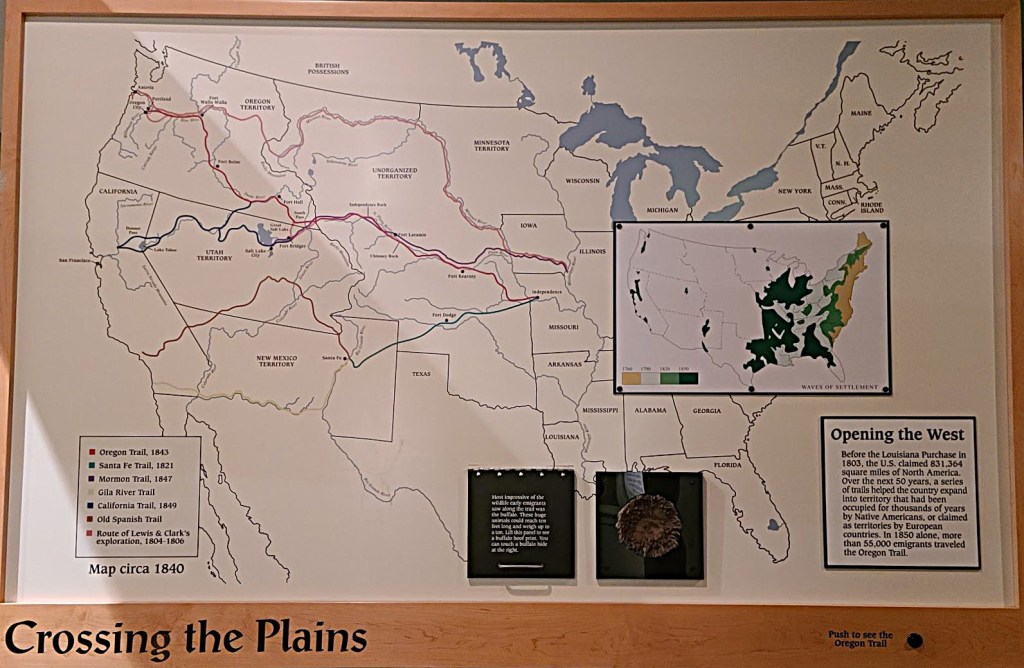
My family heritage encompasses many who made the Pilgrim-age for religious freedom, from the 1620s on, including those who left the civilization of Europe & America to pioneer/settle the wilderness: some by choice, some by force. I relate to others in law who came later–such as the early 1900s–in search of a better life, a life less dictated by difficulties imposed by constant warfare and autocracies. These are the heritage of US.
Note the inset showing waves of settlement, principally fueled by immigrants–visitor’s center at 3 Island Crossing, ID
Even though they left, they brought with them the heritage of the lands and cultures of their ancestors, my ancestors, our ancestors. Even Native Americans came from somewhere else, and brought, and amended, their cultures. I am grateful for those heritages, even despite their individual and national imperfections. I celebrate the good of every person and culture, knowing they each enrich my life. Actually, even their faults & failings enrich my life, both in consolation for my own faults & failings (since we are all human), and that I/we can learn to be more wise.
Immigrant Salads I made a few years ago to celebrate those who came to America
In my family’s past are those who fought for freedom, in wars from the American Revolution and Civil War, through more recent wars and conflicts abroad. They bore arms in defense of freedom, and they served to support those who did the physical fighting: their immediate and extended families, in particular. I have a heritage of those who fought for freedom in what they said and wrote, with their votes, and through serving in the duties and responsibilities of citizenship.
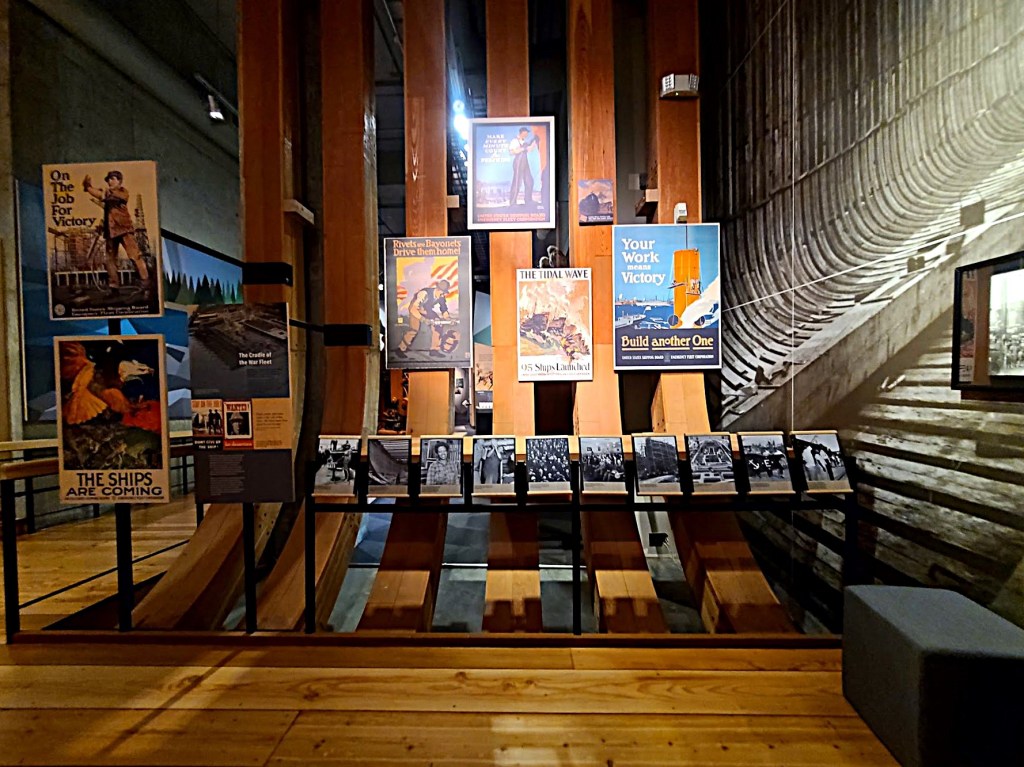
Washington State History Museum exhibit illustrating support for our troops in WWII with hard work
And I have a heritage of hard work, working through hard times, of staying the course, though long it may be. I have inherited what I value, such as honesty/integrity, kindness, learning from school and the school of Life, faithfulness & loyalty. I’m thankful to my progenitors and progeny who exemplify these in their lives.
The Statue of Liberty, courtesy Jennifer Gragg
How can I thank those who came before, and those who are yet to come, in a long chain of choices for freedom, independence, dependability, the blessings and offering of Hope these near and dear, and even those afar and unknown gave to and for me? Surely we honor best by living honorably, and I pray I will so live that I may be an influence for Good in whatever sphere I may be.
This year for my birthday I took a trip to Prosser WA for their States Day Celebration, partly as a treat for myself, partly to gather content for my Travel site. Birthday gifts: how that came about and how it all worked out.
As happens many years, my birthday was on Labor Day, which has metaphorical significance at least.
In order to be in Prosser for the beginning of the Celebration, I decided to stay over the night before. It seemed a gift that I was able to work that out. That evening I was able to reconnoiter parking and places I wanted to explore around town, and even take some photos for my site before the crowds, which also seemed gifts to me.
It was 100 degrees in Prosser, and on the way over. But the next day, the day of the parade and other events, and the day I’d be wandering about town in my wheelchair taking more pictures, the sky was overcast and the temperature in the mid 70s. What a great gift! The parade was fun: a highlight was the dancing horses. Another was the chance to chat with a local to find out something about the history of the celebration.
When I loaded into my vehicle to return home, I discovered that sometime during the day my foot had fallen off the footrest of the electric wheelchair, and the chair had chewed right through my shoe into my toes. Thus was the end of a delightful birthday! As I felt unable to cope with the little disaster on my own, I just drove back home. Even took some pictures along the way.
Once home I did what I could think to do (being maybe a bit in shock) to clean the injury, and called my sister to cry on her shoulder. She and her husband determined to drop all they had going on in their life and drive up from the southern Oregon coast the next day–a 5-7 hour drive, depending on Portland traffic. Her birth as my younger sister has been a gift to me, as well as the person she has chosen to be. She ended up staying 3 weeks, helping me and making sure I got the medical attention I needed at last, such as wound care and home health nursing. It was a dangerous wound for a diabetic paraplegic in both depth and locatio–in my extremities.
What a gift that was for me, not to have to face the troubles, frustration, care, and worry on my own! And while she stayed, we were able to do some fun things together, too–a seldom realized opportunity/gift.
My Birth Day
My mother labored to bring me into a conjugal, extended, and family lineage that gave me a sense of belonging, of being part of a higher purpose, a sense of direction and values: Truth, Beauty, and Goodness, to begin with. My parents labored to provide physical necessities, and the necessities of the soul–such as music, education & ethics, love & laughter. Of course our lives had challenges. We were not perfect, nor were they perfect. In life we suffered pains and hurts and difficulties–yet not as bad as some. These, too, have been gifts that developed who we are, who I am.
When my life suddenly jumped track due to a car accident (cause of my paraplegia) the year I turned 30, there were gifts in that as well. My mom, the driver, only suffered minor injuries, and my 4 year old daughter none. These were deeply felt gifts. And no one else was involved in the accident. Yet people were there right away to lift the car off me, and first responders were there quickly to respond.
I could have been injured far worse, or died (as well as my mom and daughter). Every other patient in the hospital with spinal cord injury when I was there, was quadriplegic. If I or my mom had been so afflicted, we could not have lived on our own, and there are much more serious health issues for quadriplegics. I knew at the scene of the accident that I was paralyzed, but felt the reassurance to my heart and mind, “This is something you can deal with”. Even though I knew that was naive, not knowing what that would entail, I knew it was important to let myself take comfort in that reassurance. I was gifted not to be plagued by “If only . . .” or, “Why me?” It has been a gift that I have not become bitter over it. Maybe that’s a gift I gave myself, but I think it not from myself alone.
An anecdote that I find humorous is when at the scene of the accident they kept asking me how old I was. Since I have a hard time remembering my age, I had decided at my previous birthday that I would say I was 30 both in the year I would turn 30, and the year I would be 30. So though I would not be 30 for a couple months, I said I was 30. They asked me so many times, I thought, “Why don’t you just write it down?” I didn’t realize until much later, in the hospital, that they were checking for brain injury!
This paraplegia, as I suppose all in life, has been a learning experience. It has been a gift to realize that this is a learning experience, despite and because of the challenges & frustrations it has brought. I have realized that the new life it has given me is not only for what I could learn, but the opportunity, even the responsibility, to be an influence in helping others through whatever challenges they might face, because they see me facing my most obvious one. A new life doesn’t necessarily mean an easier or trouble free life. But by our choices, can become one of more profound meaning and purpose. Maybe not all accidents are accidental.
My Daughter’s Birth
When I gave birth to my (first, last, most charming, beautiful, talented/gifted/intelligent, and only) daughter, she gave life to my life: a powerful purpose, joy, and reason to live. Her love and acceptance, despite my faults (of which she knows better than anyone but God) means more to me than anything or anyone (other than God’s love, mercy/forgiveness, and acceptance–now and forever).
Day of Rebirth
While being “born again” was a crucial decision I once made, every year, every week, every day dawns the birth of a new beginning to my being, and the gift that God gives to me through the gift of His Son–“For God so loved the world [and me!] that He gave His only Begotten Son . . .” The gift of that sacred Birth Day we celebrate with gift giving at Christmas. We celebrate it at Easter, and every day. It gives me Hope, Faith, and Love of/for God. It gives us reason/His expectation to love His children just as I want others to love, honor, respect, treat with kindness my daughter, and through her, the grand children that have been so great a gift to me.
Beside that great gift, are all the tender mercies He gives to me that fill my heart with joy and consolation. Beside daily bread & wherewithal, He has gifted me a beautiful earthly home & garden, and the promise of an even more beautiful heavenly home–and indeed, where His love is, is a heavenly home, no matter in this life or the next. Then we will be born into a never ending life of Joy & Peace, washed and clean, with no more tears.
Much more could be said, but my conclusion is that Birth Day Gifts are wondrous to unwrap.
The story of Isaac’s life begins long before his birth . . . possibly 75 years before his birth, with the hopes and dreams of his newly wed parents, for children. But his mother, though beautiful, was barren. Despite the promises of God to Isaac’s father (for at least 10 years) that he would have descendants like the stars of the sky, she was barren still. So she at last gives her maid to her husband as a surrogate. But the family dynamics of that connection are disastrous (in the short run . . . in the long run, nations were born of that union).
Isaac was probably only 1-3 years old when his half-brother, the teenaged Ishmael, and Ishmael’s mother were sent away. I think it fair to say that Isaac was probably doted on, by both his aging parents–possibly by the whole household. He was his mother’s only child. He was his father’s long-promised, long-awaited, covenant heir. He was their only child as a couple, and now Ishmael was no longer in the immediate picture, nor his mother Hagar.
But a rather traumatic event soon takes place. And in this, perhaps we could say that Isaac’s story had begun many generations previous . . . in a God-believing lineage from Shem, Noah, Seth, Adam . Even though Isaac’s grandfather had other gods, Isaac’s story begins with who his father was and chose to be: a man of God, a godly man (concerned with righteousness and justice), a believer in the one true God. Isaac’s father was a man that got up early to obey whatever God asked of him–even if it seemed not to make sense, even if it was heart-wrenching, even if it took a faith beyond belief.
Isaac’s father took him up to be sacrificed. At first Isaac was innocent of his father’s intentions. But soon enough he found himself the lamb on the altar. There’s no doubt that Isaac could have escaped the anticipated ending of his story, but he had enough faith, enough respect for his father, and maybe also for his father’s God, that he submitted to being bound on the altar, and the knife was stretched out toward him.
Perhaps to us it is a miracle that this experience did not embitter him toward his father’s God. We can only surmise with what feelings and faith he came away from that altar. I can imagine that he was overwhelmingly relieved at the mercy of God. That may sound strange, for God had required the sacrifice in the first place. But many other gods, or their priesthood, did not provide a ram in the thicket in exchange for human sacrifice. I can imagine that Isaac came away knowing that God did not want that kind of human sacrifice. Beside knowing that his father was totally committed to this God, he learned something about trust and faith in the extreme. And we know that Isaac chose to believe in his father’s God, and to pass that belief on to his posterity.
See Genesis 26:2-5 God appears unto Isaac and commutes the Promises He made to Abraham to Isaac, “Because that Abraham obeyed my voice, and kept my charge, my commandments, my statues, and my laws.” Perhaps as well as a reassurance, a reminder to Isaac about what God looks for when He chooses someone.
And Genesis 26:24 “And the Lord appeared unto [Isaac] the same night [that he went to Beer-sheba], and said, I am the God of Abraham thy father: fear not, for I am with thee, and will bless thee, and multiply thy seed for my servant Abraham’s sake.” (This is after Abimelech sent him packing from Gerar, and the Philistines had confiscated one well after another that he had dug . . . he must have been feeling a little discouraged, dis-heartened, and God came to give him reassurance that He would take care of him).
Isaac was 37 when his mother died. We have a clue about the closeness of their relationship in that he was still mourning her for 3 years afterward.
Isaac’s father took care for who he would marry. His father had experience with marrying from among the local women, and from the women of Egypt. They were not for his son. Abraham made his most trusted servant promise not to take Isaac back to Haran/Padan-Aram to live among his kin and their idols, but there was something about the character and attitude in the way the women were raised in the family, that made them his choice for his son. And when Isaac saw Rebekah, he loved her, and was comforted in his grief for his mother.
Like his mother Sarah, Isaac’s wife Rebekah was barren. For 20 years. (One wonders if it was a family trait). Genesis 25:21 might give the impression that only then did Isaac intreat the Lord for his wife. I suspect there was some increasingly heavy duty praying going on through most of those 20 years, by both Isaac and Rebekah. When Isaac was 60, his twin sons were born. Foreshadowing the first 40 or so years of their lives, Esau and Jacob contested even at birth, who would be firstborn.
When Isaac was 75 his father died, and he and his half-brother Ishmael buried Abraham. No mention of Keturah’s sons (Abraham married Keturah after the death of Sarah), but that doesn’t mean they weren’t there. Abraham had given them gifts (one suspects they were generous gifts) and sent them away–but he had also sent Ishmael and his mother away much earlier, with apparently not generous gifts. True, they probably felt more family obligation than we do in general in our culture, but I think in those intervening years Abraham had also made some gift(s) to Ishmael (probably at least in the wherewithal for Hagar to arrange a marriage for her son in Egypt, where she was from). So it’s hard to say what feelings Isaac and Ishmael had for each other, but they were at any rate, able to come together to bury their father. One would expect that Isaac’s feelings had less to be put aside, but then probably his mother had told him something of her perspective of how things were. Maybe not much, but enough.
Again, family dynamics come into play. Isaac appreciates his son Esau’s hunting skills, and the meat from it. Maybe he’s a man’s man. Almost predictably, then, Rebekah compensates by taking Jacob’s side. This is not to say that both Isaac and Rebekah didn’t love each of their sons. No doubt they did. But they related to them each differently.
When Esau sells his birthright (perhaps not “despising” it, but not valuing it as Jacob did), it’s not too surprising if Rebekah knew or found out about it–mothers tend to be tuned into what’s happening in the family and amongst the children. But who would dare tell Isaac? And how would one go about saying such a thing to him? It would not likely be news that he would want to believe, and might mistrust the motives of the teller of such a tale.
Another drought/famine year, so Isaac moves over closer to Gerar, and King Abimelech is apparently still alive. Isaac has no doubt heard the stories of his father’s sojourn in both Egypt and Gerar. He considers it advisable to follow his father’s strategy . . . indicating that there was reason behind Abraham’s story. Apparently not a lot of trust has grown between Abimelech and Abraham and son. The Lord had warned Isaac not to go to Egypt . . . notice that the Lord seems to keep Abraham and his posterity in a backwater while the superpowers to the north and south are flexing their muscles. And possibly various intrigues and politics make it tricky to survive in the high societies. The Covenant lineage/seed has opportunity to become stronger, more viable. When they do go to Egypt it seems to be a time of weaker Pharoahs, and when stronger one(s) come along, it’s time to get out of Egypt.
But Isaac and Rebekah can’t resist frolicking a bit, and Abimelech is clued in that they are more than brother and sister. Maybe Abimelech himself wasn’t still in his prime and ready to move in on her, but somebody in the court might have taken it into his head to have her. Abimelech either has enough conscience not to want that to happen, or he’s learned not to mess with Abraham and his son, or God might make it a misery. He puts out a pretty strict rule (a death sentence) for everybody to give Isaac and his wife wide berth.
While in Gerar, Isaac takes up farming. And he’s really successful at it. In fact he’s pretty successful at whatever he does, and the locals don’t appreciate his growing wealth and potential power. Abimelech finds it politic to ask Isaac to move on.
Isaac moves, but not too far away. It seems kind of foolish that the Philistines have filled in Abraham’s wells. But for whatever reason, they now see the value of them, as Isaac has them re-dug. They decide to confiscate 2 of them. Finally the third is uncontested. Isaac probably could have flexed his muscle and made his case at arms, but he chooses to turn his other cheek rather than instigate a war or “conflict”. Abimelech comes to him and wants to have a treaty. Isaac is a little testy after his treatment of late. But, he feasts them, and agrees to a treaty. And that same day the Lord blesses him with water in the well he’s been digging (his servants have been digging).
Esau is 40 when he marries . . . indicating that probably a man had to acquire enough property to prove he could provide for a family/tribe before marrying. He marries a couple of the local girls, and that is a “grief” to both Isaac and Rebekah.
Now Isaac is feeling his age. He’s old and can hardly see, not sure how long he’ll be in this world. Maybe he’s had a bout of illness. He wants to leave his last blessings. He begins by calling Esau, the eldest by a fraction, and asks him to go hunting and bring some of his father’s favorite venison, and then Isaac will bless Esau.
Rebekah overhears. She knows it’s Isaac’s intention to bless Esau with the blessings of the firstborn. I think Isaac still doesn’t know about the previous selling of the birthright, and I think Rebekah does. I think she also knows something about the characters of her sons, and she recognizes in Jacob one who would value the Covenant and commandments, and has the steadiness of character to keep them, and to lead the tribe responsibly. Certainly God recognized it, as we shall later see.
So Rebekah instigates a deception of Isaac. She has Jacob dress like Esau; she stews up some tasty morsels like Esau, she sends him in to his father–buttressing his doubts.
Possibly Isaac may have been suspecting something–it could be that Rebekah had pointed out to him that Jacob was the better candidate for the right of the firstborn . . . but at last he is satisfied enough to offer the blessing.
It may be a test of our faith whether we also trust that God is in charge, and knows what He’s doing; that Isaac was not only chosen by God, but was inspired by God with the words to pronounce as a blessing on his son. (Hebrews 11:20 “By faith Isaac blessed Jacob and Esau concerning things to come.”) If it were a matter for mere mortals, when Esau gets back and the switch is found out, Isaac surely could have just revoked the blessing he gave to Jacob (and probably send him packing, cursed for the deception). But it seems apparent to me that Isaac recognizes that it was God that gave him those words of blessing for Jacob, and he cannot revoke them. He then blesses Esau as well–not shabbily, but not as the firstborn.
But Esau is spittin’ nails angry with Jacob over it. Maybe not recognizing that he is just as angry at himself for not having valued what he had. He vows that when Isaac passes, he’s going to do away with his rival Jacob.
Again, Rebekah finds a resolution–for two matters. She speaks first to Jacob about going back to her brother’s house in Haran until Esau cools off (no doubt she intends to help that process–she, knowing her sons, has no doubt that Esau will carry out his threat, and she doesn’t want to lose both her husband and son “in a day”), then she approaches Isaac–let’s not have Jacob marrying someone from around here, Send him back to my brother for a wife. Otherwise, what was the point of the trouble your father went to to have me brought here?
Isaac agrees. Maybe he also has a notion that Esau might have it in for Jacob, though probably no one would tell it to his face–certainly not Esau nor Jacob. Isaac blesses Jacob, and re-affirms the blessings he had previously given. Perhaps he also sees his previous blindness, that children raised by the daughters of Heth (Esau’s wives) are not going to live up to the charge and Covenant as expected, required by God.
I doubt this was the first indication to Esau that his choice of wives was not a happy one for his parents. One would have thought the subject of appropriate marriages would have been discussed before Esau married–but it’s possible Esau didn’t inform his folks ahead of time of his intentions, or that they didn’t think he would marry without their blessing, at least. In any case, it’s now abundantly clear that they don’t approve, and he right now is seeking their approval. So next best thing, he figures, is to marry amongst his kin–one of Uncle Ishmael’s daughters.
Not much more is said of Isaac. His story is kind of overshadowed first by his father Abraham, and then by his son Jacob. He died at 180 years of age (Genesis 35:27-29). Jacob had returned from Padan-aram some while previous, quite well-to-do and with a campful of wives and kids–must have been overpowering to Isaac, who had been raised an only child, and had only 2 sons that we know of. Esau and Jacob had made peace, and they met together to bury their father in the cave that Abraham had bought for a family burial place. They were 120 years old themselves. (They were 15 when grandpa Abraham died).
The three Patriarch-Prophets Abraham, Isaac, and Jacob. Fathers and keepers of the Covenant
It seems obvious that the government of societies began as an outgrowth of the family. As children grew up, the extended family became a tribe. Tribes expanded when other individuals and groups joined a tribe, either by choice or acquisition. In an age of the nuclear family, some might question why grown children would hang around the old folks to be part of a tribe. In times of financial hardship, grown children may be very glad to be part of an extended family. Children growing up with good grandparents, aunts & uncles, and cousins can find a sense of belonging, love, and support that lasts a lifetime. Life in ancient times was difficult in different ways than today, but there were good reasons to be part of a tribe, despite examples that fall short of ideal. Elders in the tribe brought not only wisdom & experience, they brought cohesion. Mid-range members brought protection and sustenance. The young brought the possibility of continuance.
The Nuclear Family
Parents, of course, are the natural leaders of the family. Initially, children are dependent physically, emotionally and with respect to knowledge. Parents are bigger and stronger, meaning they can offer protection & sustenance, and/or command submission. When all other factors become equal or bettered by the maturation of the children, it is usual for adult children to continue to recognize the experience and leadership of the parents, by habit, out of respect, and/or because the emotional connection carries on.
As children mature, wise parents step back or share their authority. Sometimes children feel it necessary to instigate the rebalancing of control over their lives. Parents who do not exercise their authority, or exercise it in excess, may find that rebellion ensues as soon as the children can exert themselves.
There are three possible parental forms of governance: father rules, mother rules, both rule: both are involved in decision-making, each makes decisions within his/her own sphere, or each fights for dominance.
Which form of rule exists in a family depends upon the nature and disposition of each in respect to the other, and the division of labor.
A decisive or aggressive nature will tend to rule the indecisive and/or acquiescent nature; or,
The one primarily responsible for providing protection & sustenance tends to make the major decisions of how this sustenance is to be got & is spent, and where & how the family or its members will locate;
The method of child rearing often depends upon who is primarily responsible for it—this role may change as the children mature. It may also generally depend upon the sex of the child/children. The primary responsibility of rearing is still best accomplished with the accomplice-ment, or support, of the other parent—as a back-up figure in one way or another, or as joint providers/authorities.
The Extended Family or Tribe
Depending on the pattern set by the nuclear family, the leadership of the extended family may be Patriarchal or Matriarchal (where one or both of the parents is extant), more or less democratic, or by a child chosen by the parent, by several/some/few/all of the children, or by a child/children/descendant who has/have exerted him/her/themselves in some way.
A child chosen by the parent hopefully leads because of the respect the others have for the parent and his/her decision. Even if the children are successful at group or democratic decisions, as with any group, it’s helpful to have one person lead discussions and actions.
Although lineage may be reckoned either or both patriarchally and/or matriarchally, most parental and parentally derived governance has been traditionally patriarchal. One way of accounting for this is division of labor. Since only the woman can bear children, she is generally the primary child-nurturer/raiser (hopefully with the back-up of her mate). As discussed above, when the man is primarily responsible for the protection and/or sustenance of the family, it may seem natural for him to lead the family and to navigate the affairs of the family in its external interactions in the world.
Another way of accounting for the patriarchy of families is the natural outgrowth of the personalities and values of the parents and their societies. That a family or society is patriarchal doesn’t necessarily mean that women are discounted or domineered. Any wise patriarch listens to his wife, respects, and honors her. There are folk proverbs about the influence of wives on their husbands (for example, who “wears the pants” in a relationship). Additionally, due to differences in talent and personality, some women may be more comfortable, efficient, and successful filling certain roles for the benefit of the family.
The Community or Society
When a tribe grows into a community or society, especially when it settles in a certain place, its governance may grow naturally out of the leadership roles of a tribe: it may be patriarchal, matriarchal, or a society of equals. A group of humans who do not already have a leader will
Disburse or disband
Choose a leader or group of leaders
Follow a leader(s) who asserts him/herself/themselves
Be coerced by a leader or group
Since humans are social beings, they most often choose to remain in groups, so that even if a group disbands, it will tend to form smaller bands. It is possible that they will all become a bunch of hermits, but a cross-sectional sampling of humans through time and place doesn’t make it likely. The reasons for disbanding (conflicts or perhaps scarcity of resources) must outweigh the self-calculated survival (both physical & emotional) of those separating themselves. Sometimes, especially when the reason involves limited resources, the group comes back together, perhaps periodically, for social reasons, including the biological urge to reproduce effectively.
A leader may be chosen for his/her competence, his/her self-confidence, or the confidence the others have in his/her competence—which often depends upon his/her self-confidence. A leader will be followed because of his/her self-confidence, competence, and/or persuasive ability; and/or the rest of the group’s lack of self-confidence or competence.
A leader may coerce followers by physical force, mental acuity, or by emotional force. In any case, the others of the group must lack competence, self-confidence, or the cohesive ability to counter his/her coercion. Often this coercion is carried out by a smaller group that the leader relies on for support.
A group may allow to its leader(s) varying amounts of authority (and there’s a wide spectrum or sliding scale of authority, from absolutism to absolute non-existent):
Totalitarian dictatorship or tyranny
Paternalism/maternalism
Limited monarchy
Advisory
In some limited aspects
Protective (vs enemies of all or some kinds, outside and/or inside) via defensive & offensive actions
Sustenance
Social
Intellectual or instructive (usually advisory)
Emotional or religious
Recreational
People rarely “choose” totalitarian authority, though they may allow it out of fear of the totalitarian or fear of the lack of a totalitarian (Will anything less be able to pull it all together? Will everything fall apart if the tyrant is overthrown?). But totalitarianism is usually brought about by coercion of one sort or another.
Paternal/maternal authority (other than in naturally patriarchally derived governance), would usually be the “choice” of a group which follows a leader who exerts him/herself, or the general recognition of the group about the competence of that individual to lead. This authority would, in all likelihood, be expected to provide wise/expert/experienced counsel, direction, and some degree of responsibility for the physical sustenance of the group, as well as leadership vs enemies or internal conflicts.
A limited monarchial authority would be chosen by a group which trusted in the competence of its chosen leader and/or wished to leave the responsibilities of leadership on the chosen leader, without granting the monarch automatic total authority in all cases.
An advisory authority would be chosen by a group which did not completely trust its leader, or trusted the competence of the group as a whole, or its members, equally (or nearly so) as well as the leader’s competence. This group, or its members, particularly likes to make their own decisions in general, yet is a little hesitant to do so completely without some authority to advise them or to see to the enforcement of decisions.
An advisory authority might be most nearly democratic. I don’t know if there could exist a truly democratic group (unless very small), because I think almost all groups recognize some authority, whether or not it is an explicitly chosen authority, or merely a mentally/emotionally acknowledged authority, or whether the members don’t even recognize their own acceptance of that authority. One person, or group of persons, will tend to stand out ahead/above the rest as leader, and that is most convenient/efficient and workable, especially in the case of protecting the group. A truly democratic group would be the most likely of any to break up, and the larger the group, the more likely disputes/disagreements will arise, that without some leading authority may not be resolved to the satisfaction of all parties.
What authority would the leader (or leading group) chose?
The coercer(s) would, of course, tend toward totalitarianism. The leader/persuader would probably choose paternalism (though perhaps be willing to accept other forms of authority). The self-confident might choose any of the forms, depending upon whether s/he/they was/were confident, very confident, or egotistical about her/his/their abilities, and those of the members of the larger group. The competent’s choice might be any of the above, depending also on his/her/their own self-confidence, egotism, and view of the members or group as a whole.
The larger the group, the more varying is the authority of the leader(s) among its members. As the group becomes larger, the coercer must have a smaller group of strong supporters amongst the larger group. The persuader will tend to need various special-interest lieutenant persuaders for the varying support among the members. The self-confident will tend toward being a persuader, and the chosen leader will tend toward being a persuader, or need a support group of persuaders, or face the next choice of the group for a new leader or leading group, because group popularity/confidence is a flaky thing. Authority only exists by recognition, cognizant or otherwise, of those being governed.
It seems fairly obvious by now that I propose that the rule of authority is by consent of the ruled—whether this consent is willing or unwilling. If a group/population has not overthrown a ruler, it is essentially consenting, except in the case of actual physical or numerical coercion (as in a military rule).
I propose that the right to authority/rule depends on the reason for it:
Might & mightier
Competence and confidence
Chosen, chosen again, or 2nd choice
If the authority exists by might, it must bow to a mightier might. If the coercer is coerced into submission, s/he/they must bow to it in turn, whether it is an upstart or an uprising. Of course, as a coercer is a bully, s/he/they don’t care about what is fair or what the rules are, so this authority doesn’t back down easily—must be essentially crushed, possibly more than once.
Of whether “might makes right” in the case of physical or numerical coercion, that’s not really the question. It may be used as an excuse or rationale, but a bully at heart doesn’t really need a rationale. It’s merely a statement of fact in the bully’s mind, that is, “might is might”. Anyone under the thumb of a bully can only either escape or (possibly raise a clever or clandestine) revolt. Sometimes revolutionaries invite outsiders to their aid.
If a leader (or group of leaders) is chosen, s/he/they must face the fact that s/he/they may be “un-chosen”, in favor of a 2nd choice, or the 1st chosen needs to be chosen again, as popularity sways in the breeze (often blown about by competitors). That breeze, or gale, isn’t always congruent to the leader’s actual leadership abilities, except in the talent of persuasion (either the leader’s own, or the leader’s supporters).
If a leader is chosen, s/he/they must face the fact that s/he/they may be “un-chosen”, in favor of a 2nd choice, or the 1st chosen needs to be chosen again, as popularity sways in the breeze (often blown about by competitors). That breeze, or gale, isn’t always congruent to the leader’s actual leadership abilities, except in the talent of persuasion (either the leader’s own, or the leader’s supporters).
What authority/governance would the people choose?
When a group is ruled by (other than coerced) consent, the purpose and effectiveness of its governance is of the group’s (and individual’s) own choice. Pretty well all groups rely on some form of governance, even if tacitly. Members of a society may belong to more than one group or more than one governing entity:
Protection of the group or its individuals (including attacks on health, economics, land, sovereignty, etc.): defensive & offensive
Sustenance (could be governmental programs, co-ops, charities, etc.)
Social (these can be traditional government entities, social groups, and idols/influencers)
Instructional (such as intellectuals, philosophers, media, educators, bureaucracies, as well as elected officials speaking from the bully pulpit)
Religious (whether in a theocracy or a society with separate churches)
The group may choose a strictly limited or specified function for its governance: such as advisory functions, limited decision-making functions, paternalistic functions, or an autocratic function. It may choose one, some, or all of the above purposes for its governance, in varying proportions to other functions and to each function itself. But the group ought to consider before choosing, and then abide by the consequences of its decisions, in terms of what the form of authority requires of individuals, what the authority viably can provide, and how workable/effective that authority is in itself. Naturally, the group may find the need to change its choices in these considerations, but that’s not always easy. Better to be wise in the first place, take stock of past and contemporary examples, as well as using some intelligent foresight into possible consequences.
What’s the best form of Government?
The best form of government depends upon the people governed. Are they homogenous or have a high degree of variability in ideas, goals, attitudes, values? Is there a cooperative spirit among the group? If not, they are likely to disband or disintegrate. What is the size and complexity of the group and the geography of the area they inhabit?
Uninformed people need an intelligent and trustworthy, paternalistic & instructional ruler.
Busy people need representational government, such as those in subsistence agrarian cultures or in large & complex societies.
A group with finite resources, such as limited land or water, may find, at least from time to time, the necessity of a sustenential role for their government.
The more educated (not propagandized/indoctrinated) the society, the more its members ought to govern themselves. The individual governs the Self, and involves his/her Self in governmental decisions, for example, voting for representatives and laws/rules.
There must be a balance between the group standard of ethics and its laws/rules. If the standard of ethics greatly differs from the law, or a large number of the group has a differing standard of ethics, no amount of law can untangle all the loopholes which the lawless can manufacture. For instance, a theocracy would only work for a group that all believe alike. On the other hand, the more the members of the group govern themselves, the less govern-mental control must be exerted upon them. I propose that nearly any form of government can work, if the people are good/ethical/moral, and informed to the necessary degree. If an individual or smaller group does not like the laws/rules of the group, the laws/rules may be duly, lawfully changed, or the individual(s) should leave the group.
Governments must take into account human nature, which is fallible and flawed.
Rights and Freedoms
What about individual Rights? Membership in the group implies consent to its authorities & governance. Individuals may give up their rights, but groups should not take them away, though a criminal (duly convicted in an honest and just court) may be made to forfeit individual Rights by law. Trials should establish guilt, as well as protect the Rights of the individual in process of conviction.
One definition of individual Rights may be “those freedoms which may be exercised by an individual” outside any society. Certain of those freedoms end up being exchanged for the benefits of belonging to a society, including when a man joins a female’s society (such as in marriage).
In a free society, an individual has the right to make his/her own decisions about: where to live, what to do, and how to live (as long as it is lawful). The intrinsic rights of a group would include the ability to expel dissidents, to protect its own form of governance, to keep out subversives/subversions.
Conclusion
Governments grew naturally out of family structures via tribes & communities. Different forms of governance developed from the experience, needs, and nature of both those who govern and those governed. Humans are social beings, and generally belong to more than one group with functions of governance. Authority and freedom, as well as the functions of governments, inhabit a range along a spectrum of possibilities, and nearly any can be successful if the members of the group are agreed upon the rules, willing to put in the efforts required to have a successful group, able to choose for themselves, are ethical, and informed.
The Enlightenment freed us from a superstitious belief in God as the explanation for whatever we don’t comprehend. Science can explain more and more, so we don’t have to fall back on God or the miraculous for an explication of things. Right?
We understand the development of a fetus into a baby. Yet does that make it any less miraculous? Similarly, chromosomes, genes, the genome . . . all astounding, awe-inspiring, no matter how much we know about them.
I can’t personally prove that the sun will rise tomorrow. I can’t entirely explain the wonders of the Universe; I take them on faith. I have to believe that for the most part, scientists know what they are talking about, have done the work to find out, and are honest. What is faith?
“Now faith is the substance of things hoped for, the evidence of things not seen.” (Hebrews 11:1) Is that “blind faith”? We can’t see sub-atomic particles, but scientists see evidence of their existence. There’s something substantial about that. We hope for greater knowledge, and we pursue it.
Pursuing Enlightenment
“Ask, and it will be given to you; seek, and you will find; knock, and the door will be opened to you. For everyone who asks receives; he who seeks finds; and to him who knocks, the door will be opened.” (Matthew 7:7-8). In all the years I’ve studied the Bible, I don’t recall ever seeing a scripture saying, “Don’t ask”. God is not afraid of our questions. He invites us to look for answers, and I believe He often inspires people with solutions to the problems that vex them.
Ask, seek, knock. That is essentially the Scientific Method. The scientist Louis Pasteur said, “Chance favors the prepared mind.” Science requires the curious mind, the questioning mind, the observant mind, the seeking mind, the reasoning mind, the theorizing, planning, experimental mind, as well as action (knocking at Nature’s door).
God gave us those minds, those minds that are in His image. Without faith that the Universe is reasonable, and that human reason can unlock its mysteries, we would not pursue enlightenment. Note that a mystery is just something that is not commonly understood; as in Science, so in Faith.
Did God give us our minds, or did they evolve over millions of years? While some say that belief in God is unreasonable, I ask, Is it any more reasonable that the Universe, as well as our minds, could have occurred by a long, long series of accidents? Every tiny step has little chance of happening successfully (meaning survival, then replication), and the combination of millions (and more) of steps would be considered mathematically a statistical impossibility.
Humility vs Dogma
Both scientists and religionists tend to dogmatism. It’s a human flaw, expressed in the wise saying, “A little knowledge is a dangerous thing,” originally, “a little learning is a dangerous thing,” by Alexander Pope (1688-1744). Many scientific theories have been taken (and preached) as fact, yet were later shown to be misleading, incomplete, or even false. Remember the flat earth theory, the earth centrist theory?
When a scientific theory is shown to be in error, scientists don’t give up on the Scientific Method, they double down on the research, asking better questions, seeking better reasoning/logic, looking for better answers and solutions. Similarly, why give up on religion when certain religionists prove fallacious? Not all religions, scientists, nor all teachers of such, are created equal (or rather, create themselves equally valid or valuable).
We are children in our understanding of the Universe, and even of ourselves. Hopefully we are growing, maturing–not only in knowledge, but in wisdom. “When I was a child, I spake as a child, I understood as a child, I thought as a child: but when I became a man, I put away childish things.” (1 Corinthians 13:11) Being childlike (humble, curious, eager . . .) and childish (self-willed, self-centered . . .) are not the same.
Religion & Science
Are Religion and Science “at odds”, opposites? They are both ways of seeking the Truth. Each has its sphere. But like a Venn Diagram, they are not mutually exclusive. In fact, the more I learn through real science, the more I am impressed with God. Science is not well-suited to explain intangible realities such as faith, love, and the purpose & meaning of life. Like sub-atomic particles, science can observe effects, take surveys, yet these are very indirect ways to delve deeply into such important, essential questions of life.
We can benefit from ages of acquired experience and thought, even that billed “revealed”. We can admit that our minds are capable of comprehending and reacting to more than what we can directly experience or explain with our typical 5 senses (which take in data to help our minds make sense of the world). We can look for Truth in every pursuit of life, and even when we are just living it.
What Came Before?
Some question, If God created all, where did He come from? How did He come to exist? But one could just as well ask, What was before the “Big Bang”? How did the “Big Bang” come to be? Just because we don’t know or understand everything, doesn’t mean we don’t know or understand anything. It’s important to be humble; it’s also important to work with what we do know and understand, even when sometimes/often our knowledge & understanding are imperfect, incomplete.
The Problem of Evil
One of the charges brought against religion is that evil has been done in its name. Unfortunately, every institution or idea is capable of corruption. Corrupt, greedy humans corrupt any thing they can for the chance at fame, wealth, and power: governments, armies, guilds & labor unions, trade/business/commerce, industry, educational institutions, even science, as well as religion.
We’d all like to believe that scientists are utterly objective, not self-serving, but history has shown us differently. Has no scientist ever defended his views for selfish reasons? Has no evil been done in the name of science? Nazi experiments are a well-known example; more recent examples are still so controversial and politicized, it would distract from my point to detail them. Nevertheless, those examples still exist.
In Conclusion
Let’s not “throw the baby out with the bath”. Evil exists, ignorance exists, but let’s not give in to them, nor refuse to do or to see good, nor be blinded by them. Let’s keep seeking Truth, Beauty, and the Good, both through Religion and Science.







 My Stories