by Susan Ternyey, originally written in 2014
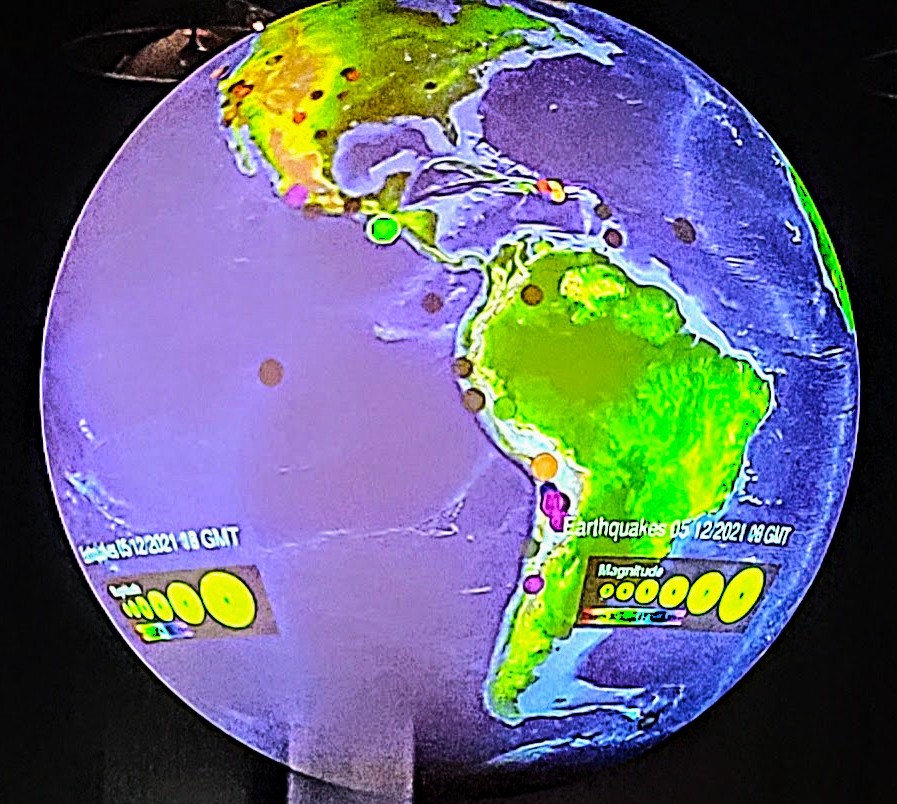
Its the beginning of a new year, perhaps a good time to contemplate our Beginning--

Comment 1
“In the beginning was the Word,
and the Word was with God,
and the Word was God.

The same was in the beginning
with God.

All things were made by him;
and without him was not any thing made
that was made.”
John 1:1-3

“By the word of the Lord
were the heavens made;
and all the host of them
by the breath of his mouth.”
Psalms 33:6

More about this later.

Comment 2
It seems to me that the events of Gen 1:1-2 (the creation of the Universe and the dark, empty, and unstructured sphere we call earth) have already happened when the Creation narrative of this earth begins on “the first day” (verses 3-5).  It is not inconsistent with the text for this Universe’s creative continuum to have lasted billions of years from its inception to this point, at which God came to contemplate this world (“Spirit of God moved upon the face of the waters”, the surface of the globe), and began its development into a habitable planet.

Comment 3
There is a certain assumption that if something can be explained (by science, for instance), it could not have been caused by God.  Likewise, there is an assumption that if God has done something, it must be inexplicable to man or science.  Yet for some of us, the more we understand about ourselves and the Universe, the more profoundly we believe that God is the Cause of it, and we are awed by His genius.
Are Science and Religion at odds?  Must they be?  Certain scientists or scientifically inclined persons, as well as certain religionists have said so.  Certain scientific and religious theories and dogmas claim so.  But human theories and dogmas have changed over the centuries, and given us ample evidence that we don’t know everything yet, and we ought to be a little humble and careful about our claims to the Truth.

My premise is that God exists (and I will discuss His character later), and that we ought to give the Bible the benefit of a suspension of disbelief long enough to consider how the scriptures might be right, instead of immediately assuming they are wrong and building up another story to try to make it fit and play like the “music of the spheres”.

Science and Religion are two fields of study—two perspectives, two observers, two witnesses—that often overlap and inter-relate.  The details of current hypotheses or understandings may not always appear to coincide either between the two, or even within the two (such as Einstein’s disagreement with quantum mechanics), but that doesn’t mean that they cannot each give us valuable insights into Truth and Reality.  Math, science, even religion, are tools in our search for understanding.  Let us not be like the 7 men of Hindustan.

Both science and religion rely on Faith, and on accepting authoritative explanations, as well as our own individual experiences, observations, reason, and sensations.  Few of us could really prove that the earth is round, even, without reference to others’ explanations and observations.  We accept the Theory of Relativity, not because we have devised it, or even hardly understand it, or could tell about our own experience with it.  We take these on faith in certain authorities in the scientific community, because we believe them to be experts, to be honest and truthful, and to have done the work of finding out.  So in religion we believe in what we have experienced, observed, as well in certain authorities that we have some reason for trusting.  Some have proven hasty or wrong, or maybe even corrupt.  But we don’t give up searching for the Truth in religious belief just because some have been proven inadequate—any more than we would stop looking to science to rethink itself and continue searching and reasoning past its faults and failures.

Comment 4
Obviously the Creation story we have in the first chapter of Genesis is not a scientific treatise.  It is a poetic version written for all humanity, and as far as we know, for all time.  How could humans 4-5000 years ago have been ready for something a scientist today would write?  The scriptures invite us to ask and to receive—I don’t recall any that say, “Don’t ask”.  God wants us to seek for wisdom and knowledge (with humility).  Part of the greatness of scripture is that you can spend a lifetime (and God commands us to do so) searching for understanding and continue to find new insights and depths of meaning.  And God has also unfolded insights, discoveries, and “Aha” moments to men who sought for understanding through scientific fields of study.  The greatest growth cannot come on a platter—our intellects are best developed through exercise.  God doesn’t give us all the answers at once—the hows, the wherefores, the what ifs—he lets us search for them; and how much better we appreciate what we have worked for!

Comment 5
First Day—Light is so perfect, so powerful a way to begin . . . physically, metaphorically, emotionally.  Perhaps as the earth cooled, the dark vapors around it cleared sufficiently to allow the light of the sun to reach its surface.  The indistinct murkiness gave way to a definite night and day, as the earth rotated in its revolutions around the sun.

Comment 6
What is a day?  The first chapter of Genesis speaks of 6 days of creation.  Genesis 2:4 says the heavens and earth were created in a day.  Some have read 2 Peter 3:8 none too carefully and pronounced that each day of Creation was 1000 years.  What it says is, “one day is with the Lord as a thousand years, and a thousand years as one day.”  In other words, one of our days can be like a thousand years to the Lord, and a thousand of our years as one day to HIm—essentially that God is not bounded, constrained, or limited by time as we are. For Him, Time really is relative, and can stretch or shrink as He wills, I humbly submit.

Look at our use of the word “day” . . . look in a dictionary, a thesaurus, any resource, and the Bible itself.  “Day” is used quite freely to associate with some time period.  “In my day . . .” doesn’t usually refer to 24 hours, nor 1000 years.  It’s an indistinct measure of time.  The “day”s of Creation could have been millions or billions of years.  I also believe that what seems impossible to us doesn’t mean it’s impossible to God.

As humans we organize, sort, arrange, and categorize things to get a better grasp of them, including time periods.  We divide the time continuum into various eras.  There’s a Precambrian era, a Cenozoic era, a Victorian era, a modern era . . . some last a long time, some are very short periods.  We group certain events that seem to be related.  No doubt a timeline can be divided in various different ways, depending on what emphasis is desired.  So, I think, with the Creation continuum.  Things may have happened in a specific order, but how they are grouped or divided, or even explained, may differ with different purposes and intents and audiences, for example.
I think that the Creation story in Genesis 1 is in the basic order of creation, with some allowance that, 1) creation was an on-going process that began with simple forms and when the stage was set for the next phase, God caused it to happen;  2) the account rather telescopes the process in order to reassure us that “God said . . . and it was so”—it happened;   3) certain parts are grouped by subject matter rather than strict chronological sequence.

Comment 7
Second Day (and Fourth Day)—“The Heavens”, atmosphere (and heavenly bodies)--It seems to me that the Creation story, and in fact the Bible, is written from an earthling’s perspective.  This doesn’t mean that God didn’t inspire it.  But humankind can understand it better from an earth-perspective than from God’s perspective.  He lets us in on His thoughts and perspectives, but we would be blown away if He fully opened up His mind to us.  He seems to always work with us humans from where we are.  Thus, the “firmament” is roughly the “sky”.  For most of mankind’s history there was not the segregation of the sky into the atmospheric elements and outer space.  Rain came down from the sky . . . so there was water above as well as below.  We speak in terms of clouds of water vapor in the atmosphere.  Later the Genesis story speaks of the stars and “heavenly bodies” being in the firmament—the sky, not the atmosphere.  Since I believe that the celestial bodies were already created, it seems to me that as the atmosphere continued to stratisfy and clarify, that the stars, sun, and moon became apparent from an earthly view.

Comment 8
Third Day—dry land and plants.  Presumably tectonic forces began to raise the land above sea level, as the crust cooled enough to become land.  It appears to possibly relate to Pangaea.

Comment 9
God prepared the earth to bring forth grass, seed plants, fruit trees . . . I don’t think they were the first plant life He created or caused to develop on the earth, but for early mankind, they were recognizable species of plant life that God eventually developed on the earth (or grasslike and treelike plants, once there was dry land for them to grow on).  For some, the idea that God didn’t just magically poof everything into full blown existence somehow lessens God’s glory in their eyes.  The idea of magic still sparkles in humankind’s childlike mind.  But as Paul said, “When I was a child, I spake as a child, I understood as a child, I thought as a child:  but when I became a man, I put away childish things.  For now we see through a glass, darkly; but [someday] face to face: now I know in part; but then shall I know even as also I am known.”  1 Corinthians 13:11-12

The record is careful to say that each plant bore its own seed, after its own kind.  God created plants with the ability to change within certain limits, or we could not have developed the astounding foods we have access to today,  But individuals or their DNA  that mutate beyond a certain point don’t produce better survival, but worse.

Comment 10
Fifth Day—sea life and birds
Next the sea life and birds.  Again, I don’t think God started with whales and condors.  “Let the waters bring forth abundantly . . .” is more like the opening of a great performance, if you will—the performance of God’s command . . . a great symphony of many instruments that began with a single or a few, and grew into such an one to fill the earth.

I believe that God created the world for us.  He prepared it for us to live on.  He gave it the resources we would need . . . including the plant and animal life that would one day become fossil fuels.  So what if it took millions or billions of years . . . time is not an issue for God.  When one phase of His creation was done, there was an extinction, and a new phase of creating life.  Science used to so emphasize that everything on earth only happened extremely slowly—no cataclysms.  Now it is recognized that cataclysms have occurred (and can happen again), extinctions have occurred, and other life forms seem to bloom into existence.

But again, God set limits on the species—each brought forth “after their kind”.  God can create species as He pleases—they do not somehow evolve by a series of fortunate but highly unlikely accidents toward some end that could not be foreseen nor prepared for by mutating individuals of lesser intelligence and their DNA.  And some call Creationism far fetched?  One of the reasons for aging the earth and universe in such long time frames is under the pretense that over those millions of years such an unlikely chain of accidents could happen and result in the variety of life on earth today.  I don’t know how much time Creation took, nor exactly how He caused it to happen (though even men have been able to change genetics by fiddling around with DNA—not by accident), but I am certain that God directed it.

Comment 11
Sixth Day
Land animals and mankind.  Cattle, creeping things, beasts:  hooved animals, small creatures, animals with paws . . .  sample species of animalia.  Each bearing young within the limits of its effective DNA.

Comment 12
“Let us make [mankind] in our image . . .”

Who is the “us”?  We have seen that St. John identifies Jesus Christ as being with God in the beginning, and in fact being the one who did the actual creating under the direction of His father (John 1:1-3).  See also:

John 17:5
[Jesus prayed:]
“And now, O Father,
Glorify thou me
With thine own self
With the glory which
I had with thee
Before the world was.”

Ephesians 3:9
“. . . God, who created all things
by Jesus Christ”

Hebrews 1:1-2
“God, who at sundry times
and in divers manners
spake in time past
unto the fathers
by the prophets,
Hath in these last days
spoken unto us by his Son,
whom he hath appointed heir of all things,
by whom also he made the worlds”

It seems apparent in these verses that although Jesus was a God in the sense of being a Creator, He is yet the Son of His Father.  What does it mean to be “with” someone?  It doesn’t mean to be that someone.  There are many verses of the Bible that support this, not the least being Jesus’ baptism, wherein while He was on earth getting baptized, His Father spoke from Heaven to say how pleased He was with Jesus.  (Matthew 3:13-17)  What would be the point of some divine ventriloquism?  Jesus many times distinguished between Himself and His Father, such as when He appeared to Mary after His resurrection:  “Jesus saith unto her, Touch me not, for I am not yet ascended to my Father:  but go to my brethren, and say unto them, I ascend unto my Father, and your Father, and to my God, and your God.”  (John 20:17)  He refers to His Father as also their Father . . . so if we interpret this to mean His Father is Himself, then His Father must also be His disciples’ selves.  Of course Jesus was accused of blasphemy for saying He was the Son of God, “Therefore the Jews sought the more to kill him, because he not only had broken the Sabbath [in their opinion], but said also that God was his Father, making himself equal with God.”  (John 5:18) He also identified Himself as Jehovah, the God of the Old Testament, when “Jesus said unto them, Verily, verily, I say unto  you, Before Abraham was, I am” (John 8—starting in verse 12, Jesus’ controversy with his adversaries over who He was), and they tried to stone Him to death for blasphemy.

Comment 13
“Let us make man in our image” (Genesis 1:26).  See also:
Genesis 5:1-2
“This is the book of the generations of Adam.
In the day that God created man,
in the likeness of God made he him;
Male and female created he them:
and blessed them,
and called their name Adam,
in the day when they were created.”

Hebrews 11:1-3
“God, who at [various] times
and in [different ways]
spake in times past
unto the [ancestors of the Jews]
by his prophets,
Hath in these last days
spoken unto us by his Son,
whom he hath appointed
heir of all things,
by whom also he made the worlds;
Who being the brightness of his glory,
and the express image of his person,
and upholding all things by the word of his power,
when he had by himself purged our sins,
sat down on the right hand of the Majesty on high . . .”

No wonder that He told his disciple Philip “he that hath seen me hath seen the Father”  (John 14:9)  And yet He was not His own Father, as He sat down on His Father’s (“Majesty”) right hand, and was His Father’s heir.

Colossians 1:12-17
“Giving thanks unto the Father,
which hath made us meet to be partakers
of the inheritance of the saints in light:
Who hath delivered us from the power of darkness,
and hath translated us into the kingdom of his dear Son:
In whom we have redemption through his blood,
even the forgiveness of sins:
Who is the image of the invisible [unseen] God,
the firstborn of every creature:
For by him were all things created,
that are in heaven, and that are in earth,
visible and invisible,
whether they be thrones, or dominions, or principalities, or powers:
all things were created by him, and for him:
And he is before all things, and by him all things consist.”

Since Jesus was not firstborn of every creature on this earth, this scripture must be speaking of being firstborn in heaven, where he was when he created all things.  God is “invisible” to us ordinary mortals, but the heavens were opened to Stephen . . .

“ But he, being full of the Holy ghost,
looked up steadfastly into heaven,
and saw the glory of God,
and Jesus standing on the right hand of God,
And said, Behold, I see the heavens opened,
and the Son of man standing on the right hand of God.”  Acts 7:59

Comment 14
“and let them have dominion”
Domination has got a bad connotation in our day.  But there’s more than one way to dominate, to rule, or to be responsible for.  Our species does dominate all others—we decide their fate.  But we can take responsibility for them as a stewardship rather than as extortionists and exploiters.

Comment 15
God told the first humans that all the seed bearing vegetation and trees were to provide food for not only humans, but for the beasts, birds, and  small animals.

Comment 16
God saw that everything He had created was very good—this includes the humans He had made.  His first commandment to them was to multiply.  He blessed them, and was pleased with them.
from https://scripturescript.wordpress.com/2014/01/05/comments-on-creation/
Genesis 2:4
These are the generations of the heavens
and of the earth
when they were created,
in the day that the Lord God made
the earth and the heavens.
Genesis 2:1-4 really belong as part of the first chapter of Genesis. Genesis 2:5-7 could be a sort of recap, restatement in other terms, of Creation. And the rest of chapter 2 adds details to the story.
Genesis 2:5-6
[At the time that God created the world and all . . .]
And every plant of the field
before it was in the earth,
and every herb of the field before it grew:
for the Lord God had not caused
it to rain upon the earth,
and there was not a man to till the ground.
But there went up a mist
from the earth,
and watered the whole
face of the ground.
Some have considered Genesis 1 and 2 to be at odds with each other. Some have said that one was what God planned to do, and the other the carrying forward of the plan. Some have said one was a spiritual creation, and one a physical creation. God only knows. But as I read and ponder these verses, and try to imagine what might have been happening, I look carefully at the words . . .
1. Compare the creation of plant life, Gen 1:11-12, with Gen 2:5-6 . . . the latter talks about plants “of the field”.
2. Gen 2:5-6 talks about these plants of the field before they grew on earth.
4. And why was this before they grew on the earth? Because
a. it had not yet rained
b. there wasn’t any man to till the earth
Why should those things matter? There was a mist that rose up to water things. But it seems to me that this verse is talking about the inception of agriculture. Agriculture requires a man to “till the earth”. It generally involves rain and directing water that originated as rain. It involves not just plant life, but plants “of the field”. I think the plant life was there, but agriculture turned plant life into food. Of course there are hunter-gatherers, but civilization and population could bloom when agriculture took hold. More about this below.
What does the mist rising up from the ground tell us about the earth at this stage? Probably a humid, moist climate, something akin to a hot steamy jungle? Perhaps still not a very highly stratisfied atmosphere. Perhaps lots of greenhouse gases keeping temps up so that water vapor rising doesn’t hit cool air that turns it into rain.
Genesis 2:7
And the Lord God
formed man of the dust of the ground,
and breathed into his nostrils
the breath of life;
and man became a living soul.
It doesn’t seem likely to me that God created a man on the earth before all other life. It does seem likely that when he created mankind, He gave them the intellect, inspiration, instruction to develop agriculture from original species that had the potential of sustaining the human family.
“The dust of the ground” is essentially the elements of the earth–which make up our bodies.
The Bible doesn’t say man was poofed into existence, but that he was formed from material already available. How did God “form” man? That He didn’t say here. Obviously He knew how to put things together. Scientists now days have learned to grow tissues in a lab, and God with His vastly superior intellect knew how to give those tissues life. Not just any kind of life, but a life with a unique soul.
That the same story can be told in many ways doesn’t make it any less true or valid.
from https://scripturescript.wordpress.com/2014/01/07/creation-2/
 My Stories