by Susan Ternyey, 1980s
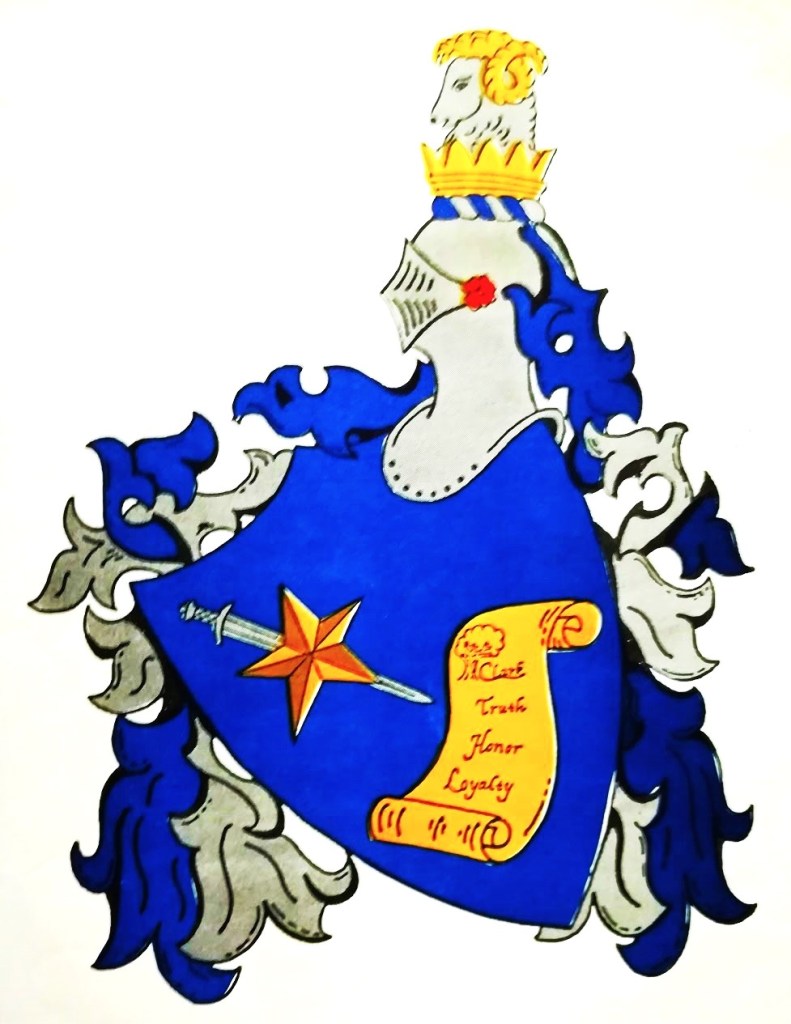
Far humbler than the poet whom I appeal
As tutor, in aspiring to convey
And 'scribe in characters of the Ideal
Those worthy merits, in this worldly fray,
Which we would urge on any that we may--
Most 'specially our children and their own--
That seem to us appropriate array
For one who hopes to win wherewith to don;
I, trembling, take my pen and timid make this poem.

In olden time when poets sought to rhyme,
A meter and a rhythm they adop'd--
Adhered they well to form they self-assigned--
In the present matter so I shall opt.
Ancient symbol rallied ardor, held aloft,
So too, our clan designed a coat of arms:
Historic emblem, archetype undrop'd,
Not obsolete, though touched by modern larmes--
So may this verse prevail with such archaic charms.

Then, too, the poet would sincere implore
To help him in his overwhelming charge
Some muse, or two, or even yet a score--
Whomever may've been roaming then at large.
But I must, sadly, thus my work dispar'ge:
That I have none of Muse to help amuse.
So if I'm dull or my meter seems to barge
The very doors of hearing, and you lose
The sense--you then may well my labors all refuse.
"A Gentle Knight was pricking on the plaine,
Ycladd in mightie arms and silver shield . . ."
Edmund Spencer, The Faerie Queene
"Come forward sir," the heralde loud doth crie,
"Show forth thy colours, blazon aegis bold.
Tell out thy kin, thy motto carry high--
If thou art noble, thy heritage up-hold!"
Proud the champion raised, the crowd behold:
Th' exalted standard gleamed so splendidly
The trumps blared out as if they had been told,
And steed and man reared up in harmony;
Then all the crowd roared out a shout majestically.

Who is this knight, magnificent to see?
Interpret now his lordly coat of arms.
A ram, as head, depicts his family:
For Rahms who came of Switzer, land of farms--
Hallau yet bears the Ram-crest o'er its barns.
Harry, born Rahm, transmits this legacy
Of strength--in silver-grey the pledge is sworn:
Not only strength, but adding Purity.
In blue discerne ye Honour, Truth, and Loyalty.

Precious yellow gold, valued, ever-searched,
Crowning richly earthly kings--but, seeks he
Honour more precious, more valuable Truth,
A more kingly crown:  priceless Loyalty.
A crown, in truth, denotes proud royalty,
And so traced in his ancestry are kings;
Of Heaven, too, his worth comes honestly--
Redeemed from Death, to Christ he stalwart clings,
And of God our Father his soul took buoyant wing.

Chivalrous Knight, protect from every foe
Thy Kindred, thine Honor, and thy Beloved,
As thy helmet protects thee from death's blow;
These look to thee, their defense--so do prove
Nor whom, nor what, nor traps for them awov'n
Shall bring them down to ruin or ravage dread--
Evil by thy tongue or sword is cloven;
Nor let thy cherished want in lack of bread,
But give thou of thy board, and of thy table, spread.

Thy shielde bear'th bravely sword and star and scroll;
The sword points to thy virtues previous told--
Defend them well, let not that keen edge dull;
But n'er aggressor, as the pattern old
Intended not, provoking, to be pulled.
The star points, too, give direction and light
To those who watch the Heav'ns as they unfold--
Wise men, the ancients mapped the starry night,
And sought for, ever, knowledge, prophecy, and Right.

Upon the scroll a tree be ascertained,
Symbolic Knowledge, Life, and Family.
Both generations gone and that remain
Are written in its branches, rootes, and leaves:
An unfinished legende that grows and breathes;
On other leaves are written all the lives
For those who come yet later in Life's weave:
A tapestry of children, husbands, wives . . .
Many-colored coats . . . some leaving, some just arrived.

A braid entwines six offspring bound in love,
Resolved amongst them to the self-same end,
That like them, all their children will be one:
Stars that in their spheres to harmony lend,
Each his own part, each his voice well blends
In order, method, symmetry--transposed
To meet each challenge Life may haply send;
In other key the melody composed
Sings still as sung before, and on and on it flows.

And tell us of the flow'r he wears so gay,
And whose that mantling scarf may be--her name.
The Rose is Vera, Gerber was she nee,
Then married Harry, Clark she then became.
For he, as child, when adverse trials came,
Was fostered by the Clarks--the scroll recalls
That "clark" and "clerk" once were the very same.
So Rahm was Clark, and Vera, Clark--it falls
That tot and tribe are known now as "the Clarks", withal.
 My Stories